- General Videos
- Music
- Economics
- Health
- Travel & Events
- History
- Psychology
- Spirituality
- Movies
- News & Politics
- Kmtyw Combat Sciences
- Ɔbenfo Ọbádélé Kambon Videos
- Ɔbenfoɔ Kamau Kambon: Black Liberation Philosophy
- Science, Tech, Engineering and Math
- Permaculture
- Self-Sustainability
- Living Off Grid
- Yoruba Language Learning
- Education
- Mmɔfra Adesua
- Nana Kamau Kambon Playlist
- Livestream
- Komplementarity Kouples and Revolutionary Singles
- Abibitumi Film Series
- Decade of Our Repatriation
- Live
Top videos


A disturbing trend has taken root all over the Sub-Saharan Africa of Asian working men getting the local women pregnant and abandoning the children or even killing them.
SUPPORT ME FAMILY -
https://www.paypal.me/JavenB123
FACEBOOK - https://www.facebook.com/Javen.Bullet...
TWITTER - https://twitter.com/Javen_Bullets
INSTAGRAM - https://www.instagram.com/javenbullets/

Tony & Ayo left everything behind to build something real in Ghana. This is their genesis story.
In Episode 1 of Bootstrap Genesis, we sit down with them to talk about the expat journey, building trust, and what it really takes to call a new country home.
🎬 Look for the next episode in May 2026.
📍 Filmed in Accra, Ghana
🔔 Subscribe and hit the bell so you don't miss an episode.
#bootstrapgenesis #leavingtobuild #episode1 #tonyandayo #expatlife #ghana #accra #entrepreneurstories #documentaryseries #yourstoryamplified


What do tomatoes have to do with mass migration? Tomatoes are a poker chip in global trade policies. Subsidized products from the EU, China and elsewhere are sold at dumping prices, destroying markets and livelihoods in Africa in the process.
Edward still harvests tomatoes. But he is no longer on his own fields in Ghana. He now works on plantations in southern Italy under precarious conditions. The tomatoes he harvests are processed, canned and shipped abroad - including to Ghana, where they compete with local products. The flood of cheap imports from China, the US and the EU has driven Ghana’s tomato industry to ruin. Desperate farmers find themselves having to seek work elsewhere, including in Europe. For many, the only route available is a dangerous journey through the desert and across the Mediterranean. Ghana is a nation at peace, a democracy with free elections and economic growth. Nonetheless, tomato farmer Benedicta is only able to make ends meet because her husband regularly sends her money from his earnings in Italy.
A former tomato factory in Pwalugu, Ghana, illustrates the predicament. This factory once helped secure the livelihood of tomato farmers across the region. Today it lies empty, guarded by Vincent, a former employee who hopes to keep it from falling into ruin. In the surrounding region, the market for tomatoes has collapsed and most farmers are no longer growing what could easily be Ghana’s ‘red gold’. An agricultural advisor is trying to help local tomato farmers, but has little by way of hope to offer. Conditions like this are what drive local farmers to cut their losses and head for Europe. Once in Italy, migrants from Ghana and other African countries are forced to live in desperate conditions near the plantations. They work as day laborers for extremely low wages, helping to grow the very tomatoes that are costing people back home their work and livelihoods. These days, canned tomatoes from China, Italy and Spain are available for purchase on the market of Accra. Some may call this free trade. But economist Kwabena Otoo says free trade should open doors; not destroy people’s lives.
Every two seconds, a person is forced to flee their home. Today, more than 70 million people have been displaced worldwide. The DW documentary series ‘Displaced’ sheds light on the causes of this crisis and traces how wealthy industrialized countries are contributing to the exodus from the Global South.
Oil and ruin — exodus from Venezuela: https://youtu.be/pNDJSp8FCjI
Drought and floods — the climate exodus: https://youtu.be/PjyX5dnhaMw
--------------------------------------------------------------------
DW Documentary gives you knowledge beyond the headlines. Watch high-class documentaries from German broadcasters and international production companies. Meet intriguing people, travel to distant lands, get a look behind the complexities of daily life and build a deeper understanding of current affairs and global events. Subscribe and explore the world around you with DW Documentary.
Subscribe to:
DW Documentary: https://www.youtube.com/channe....l/UCW39zufHfsuGgpLvi
DW Documental (Spanish): https://www.youtube.com/dwdocumental
DW Documentary وثائقية دي دبليو: (Arabic): https://www.youtube.com/dwdocarabia
For more visit:
http://www.dw.com/en/tv/docfilm/s-3610
Instagram:
https://www.instagram.com/dwdocumentary/
Facebook:
https://www.facebook.com/dw.stories
DW netiquette policy: https://p.dw.com/p/MF1G


Pumping water to irrigate, or water, crops in fields can be expensive, even when there is a river nearby. In Africa farmers are using the sun to provide the power to deliver just what the plant needs - one drip at a time.
Find out more about farming on the LEAF Virtual Farm Walk website, www.virtualfarmwalk.org

Welcome to candid Africa in this video we look at Kwame Nkrumah's Prophetic Warning on DR Congo the Heart of Africa but No One Listened
Chapter 1: 0:00 Candid Africa Intro
Chapter 2: 0:09 The Congo: A Wound in Africa
Chapter 3: 0:24 The Assassination of Patrice Lumumba
Chapter 4: 0:53 The Role of the United Nations
Chapter 5: 1:12 Opportunities for a Settlement in the Congo
Chapter 6: 1:44 The Importance of an African Framework
Chapter 7: 2:12 The Congo as the Heart of Africa
Chapter 8: 2:54 Africa is Watching
Kwame Nkrumah Prophetic Warning on Congo the Heart of Africa but No One Listened https://youtu.be/7p_u4D4w47o #africa #africaspeeches #speech
-~-~~-~~~-~~-~-
Thank you for watching @2nacheki Kindly show us Africa is Watching by Liking, Subscribing, and Sharing this video with friends and family. To directly support us you can become a Channel Member, a Patreon, or Give us a Super Thanks.
Please contact us for tips, content submission, Ads, Takedowns, Collabos, Complaints, Reporting, and Inquiries.
-~-~~-~~~-~~-~-

Theft of Railway Assets: Sector Minister calls for public support to curb menace - Joy Business Prime (17-6-21)
#Theft_of_Railway_Assets
#JoyNewsPrime
#MyJoyOnline
https://www.myjoyonline.com/ghana-news/
Subscribe for more videos just like this:
https://www.youtube.com/channe....l/UChd1DEecCRlxaa0-h
Click to this for more news:
https://www.myjoyonline.com/
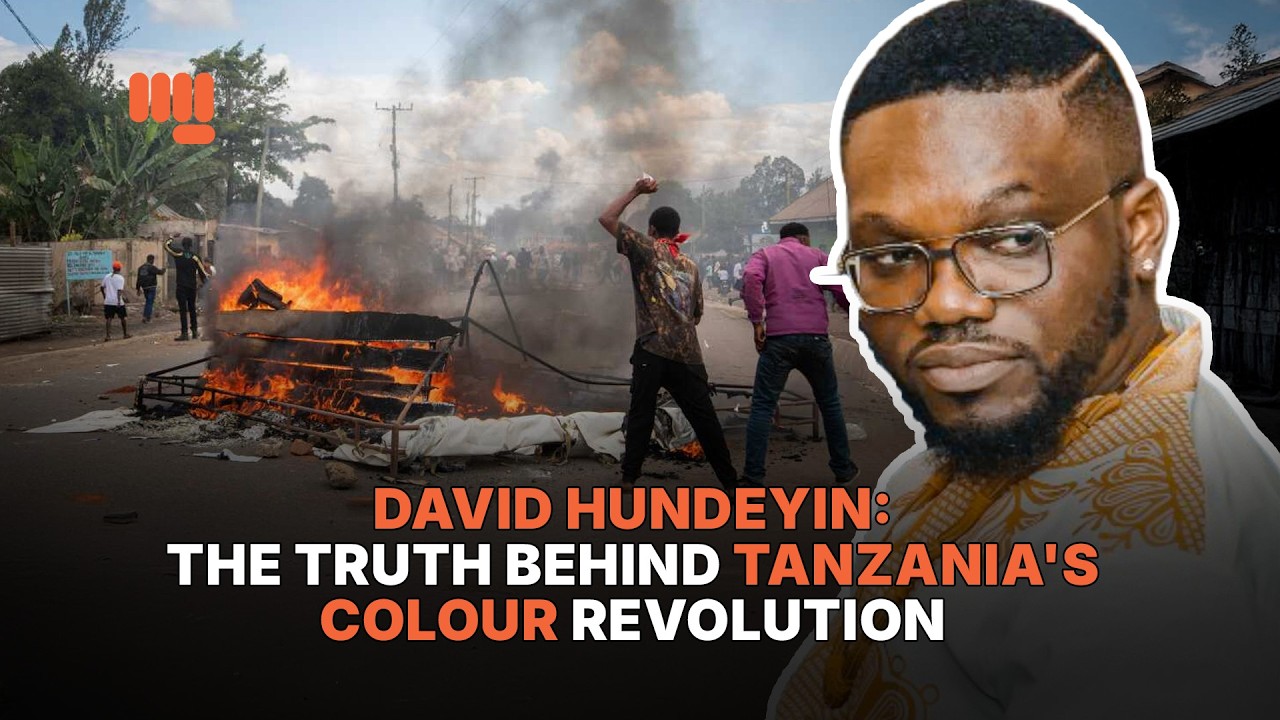
Long before polls even opened in Tanzania's October 2025 presidential election, Western media had already scripted the outcome in advance. 'Despotic' president Samia Suluhu Hassan would win a rigged contest. Her main opposition would be banned. And an organic, 'nonviolent' protest movement would be ruthlessly crushed at the cost of thousands of lives. In his explosive new documentary, 'What Happened on October 29?', Nigerian journalist David Hundeyin exposes the sordid truth behind this narrative. The mass graves breathlessly reported by CNN are nowhere to be found. The 'open source intelligence' on Tanzania's alleged crackdown comes direct from the UK Foreign Office. And the money trail behind the supposedly 'grassroots' protest movement leads straight to the Ford Foundation, a longtime proxy of the CIA.In this in-depth interview with Ahmed Kaballo of Sovereign Media, Hundeyin walks us through his findings. He makes an impassioned plea for Africans to resist the siren song of colour revolution, having seen one rob his native Nigeria of its future in 2015. He notes that Tanzania's unrest has nothing in common with Kenya's organic, anti-imperialist movement against William Ruto's Finance Bill. And he draws sobering lessons for Africa, and the Global South at large, in their struggle for sovereignty against the Western NGO-industrial complex.'What Happened on October 29?' can be streamed in full on YouTube through David Hundeyin and African Spearhead's channels.#tanzania #globalsoth #africa #sovereignty #antiimperialism



How did scholars begin to decipher ancient scripts like the hieroglyphs?
Subscribe for regular science videos: http://bit.ly/RiSubscRibe
Buy Andrew's biography of Jean-François Champollion "Cracking the Egyptian Code": https://geni.us/WQwD
Very soon after the birth of the first written language - cuneiform - ancient Egypt developed its own writing: the hieroglyphic script, immortalised in the Rosetta Stone kept in the British Museum, which consists of a single royal edict, dated 196 BC, written in the hieroglyphic, demotic and Greek alphabetic scripts.
Andrew Robinson is the author of more than twenty-five books, issued by leading general and academic publishers. In addition to "Cracking the Egyptian Code", they include "The Last Man Who Knew Everything" (a biography of Thomas Young): https://geni.us/XIBXvR , and "Lost Languages: The Enigma of the World’s Undeciphered Scripts": https://geni.us/iqP0Q. A former literary editor of The Times Higher Education Supplement, he also writes reviews and features for newspapers, magazines and journals, in both the arts and sciences.
This talk was filmed in the Ri on 18 January 2019.
Watch the second talk on ancient codes, all about the cuneiform language by Irving Finkel: https://youtu.be/PfYYraMgiBA
---
A very special thank you to our Patreon supporters who help make these videos happen, especially:
Dave Ostler, David Lindo, David Schick, Erik Shepherd, Greg Nagel, Ivan Korolev, Joe Godenzi, Julia Stone, Lasse T. Stendan, Lester Su, Osian Gwyn Williams, Paul Brown, Radu Tizu, Rebecca Pan, Robert Hillier, and Roger Baker.
---
Subscribe for regular science videos: http://bit.ly/RiSubscRibe
The Ri is on Patreon: https://www.patreon.com/TheRoyalInstitution
and Twitter: http://twitter.com/ri_science
and Facebook: http://www.facebook.com/royalinstitution
and Tumblr: http://ri-science.tumblr.com/
Our editorial policy: http://www.rigb.org/home/editorial-policy
Subscribe for the latest science videos: http://bit.ly/RiNewsletter
Product links on this page may be affiliate links which means it won't cost you any extra but we may earn a small commission if you decide to purchase through the link.


Creative idea to use free gas from garbage#biogas_plant #gas_free #fabricated_5_minutes #m4_tech #biogas Materials required:1➡️Ball Valvehttps://amzn.to/2HAXXlT2➡️Brass Tee Barbhttps://amzn.to/34sgfhLhttps:/..../amzn.to/35EO3aK3➡️B Hose Fitting https://amzn.to/3jpDrS84➡️Gas pipehttps://amzn.to/35Bzc0P5➡️Gas stovehttps://amzn.to/2HzS7AP6➡️Hose Clamphttps://amzn.to/2HGdP6s7➡️PVC Pipe 6''8➡️Water Tank/ Pvc Oil Drum9➡️Gas Container10➡️Etc➡️Facebook Page: https://www.facebook.com/MH4TECH123➡️For business inquiries: mohibulhasan031@gmail.com Music by:Soaring by Ghostrifter Official https://soundcloud.com/ghostrifter-of... Creative Commons — Attribution-ShareAlike 3.0 Unported — CC BY-SA 3.0Free Download / Stream: https://bit.ly/al-soaringMusic promoted by Audio Library https://youtu.be/fCqo2k2wG2UReady for Summer by Roa https://soundcloud.com/roa_music1031 Creative Commons — Attribution 3.0 Unported — CC BY 3.0Free Download / Stream: https://bit.ly/al-ready-for-summerMusic promoted by Audio Library https://youtu.be/yiR-hhoV9TU


ORFC Global 2021 Session
West African Farmer Testimonies: How We Are Overcoming the Crisis of Climate Change in the Sahel Through Natural Regeneration of Trees on Our Farms
Small-scale farmers in the 16 countries of the Sahel in West Africa face a dual crisis to their livelihoods: climate change and land degradation.
For many generations, farmers had lived and farmed in equilibrium with the natural environment. They maintained soil fertility, water holding capacity and crop production through fallowing and other practices.
Today, population pressure, climate change, soil erosion, misuse of agrochemicals have reduced the resiliency and sustainability of the farming system. Farm communities have become highly vulnerable to drought. Hunger and chronic malnutrition have increased.
This session highlights the testimonies of farmers, men and women, from 4 countries in the Sahel in overcoming these problems. They represent a wider movement adapting the principles of “agroecology” (learning how to work with nature). This grassroots, farmer-led movement has achieved remarkable success in transforming landscapes, adapting to climate change, regenerating their soils, and improving their food security.
Their inspiring testimonies show how human determination, innovation, and collective action have brought hope to one of the most ecologically fragile, crisis prone areas in Africa.
Speakers:
Tsuamba Bourgou
Fatou Batta
Dan Banuoku
Chair:
Peter Gubbels
#ORFCGlobal
https://orfc.org.uk/

www.patreon.com/WithoutHistory....buymeacoffee.com/Wit 11. Hannibalhttps://youtu.be/UPBDTJ4gZI0Ep 21. The TRUE Annunaki | 4K documentaryhttps://youtu.be/CWGpxvHIDwoEp 19. BAFFLING evidence uncovered - bigger than Atlantis... 4K documentaryhttps://youtu.be/ziJcn93fslc Ep 18. ELIZABETH SUPPRESSED, Primary accounts of Black Nobility in Europe...https://youtu.be/7KGAXEV0VcMEp 16. SHOCKING genetic study show that ancient China and Japan were started by the people fromhttps://youtu.be/hXHQVVKPmsIEp 14. Recent Genetic Studies on Ancient Egyptians Finally Show That They Were ...https://youtu.be/BQpsdxgpg4kQueen Hetepheres Ihttps://en.wikipedia.org/wiki/Hetepheres_I Egyptian and Nubian Deitieshttps://www.worldhistory.org/a....rticle/885/egyptian- https://www.neferchichi.com/egyptian-gods-apedemak Nubian Tattooshttps://nilescribes.org/2018/0....3/10/scribal-spotlig ISourceshttps://youtu.be/cj1_bGSUkd0?si=HrZ570_sSM1bbjDh Egypt vs Nubiahttps://www.youtube.com/watch?v=O-cID_F2_PU Egypt and Nubia were the samehttps://www.youtube.com/watch?v=aFfJ13wNwJgNubia is of equal importance to Egypthttps://www.youtube.com/watch?v=dRL6EDWfqMs https://youtu.be/DXbOg0kTRtc?si=aV9L-7wc7wAJ7USM https://www.youtube.com/watch?v=iwelEwnY70AAt 53m Egypt is an African civilization