- General Videos
- Music
- Economics
- Health
- Travel & Events
- History
- Psychology
- Spirituality
- Movies
- News & Politics
- Kmtyw Combat Sciences
- Ɔbenfo Ọbádélé Kambon Videos
- Ɔbenfoɔ Kamau Kambon: Black Liberation Philosophy
- Science, Tech, Engineering and Math
- Permaculture
- Self-Sustainability
- Living Off Grid
- Yoruba Language Learning
- Education
- Mmɔfra Adesua
- Nana Kamau Kambon Playlist
- Livestream
- Komplementarity Kouples and Revolutionary Singles
- Abibitumi Film Series
- Decade of Our Repatriation
- Live
Top videos


It's hard to believe but silver was at one time worth more than gold. China used silver as their currency and the West had to pay in silver for Chinese goods. This angered the British and so they sought a commodity that the Chinese would be forced to buy. China did not covet any goods that the West had except one: Opium.
Join the Absolute History club to get access to exclusive member benefits! 💚
https://www.youtube.com/channe....l/UCr5qeBG9g7bGtMGyH
📺 Discover the past on History Hit with ad-free exclusive podcasts and documentaries released weekly presented by world-renowned historians Dan Snow, Suzannah Lipscomb, Matt Lewis, and more. Get 50% off your first 3 months with code ABSOLUTEHISTORY 👉 https://access.historyhit.com/
This channel is part of the History Hit Network. Any queries please contact: owned-enquiries@littledotstudios.com
#absolutehistory


A Sumatran orangutan in Indonesia has self-medicated using a paste made from plants to heal a large wound on his cheek, said scientists.
It is the first time a creature in the wild has been recorded treating an injury with a medicinal plant.
After researchers saw Rakus applying the plant poultice to his face, the wound closed up and healed in a month.
The behaviour could come from a common ancestor shared by humans and great apes, scientists have said.
Subscribe here: http://bit.ly/1rbfUog
For more news, analysis and features visit: www.bbc.com/news
#orangutan #indonesia #bbcnews

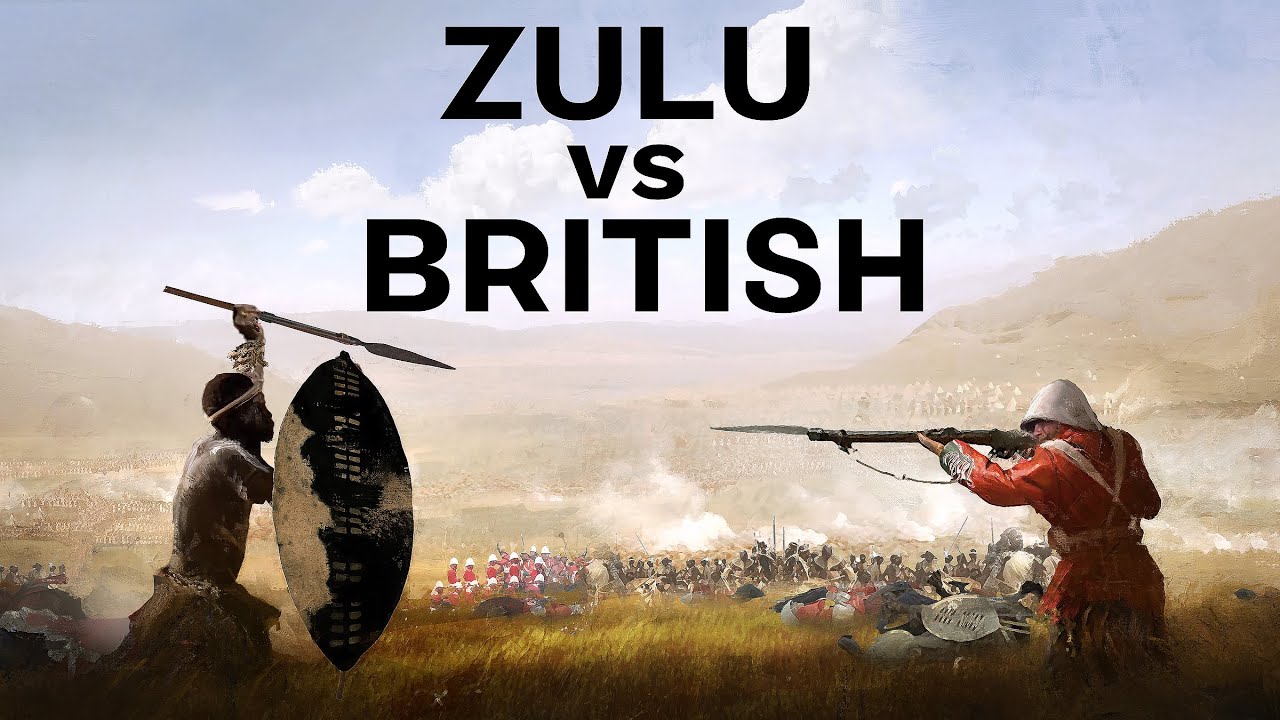
The Anglo-Zulu War erupts as British troops cross into the Zulu Kingdom of present-day South Africa. Behind King Cetshwayo, the mighty Zulu warriors make a defiant stand against the largest empire on earth in fateful battles at Isandlwana, Rorke’s Drift, and Ulundi. What follows is disastrous and fateful British vs. Zulu combat.
—----------------
SUPPORT OUR CHANNEL
Join the Patreon here!
https://www.patreon.com/historydose
ORIGINAL ART PRINTS
https://joseph-feely.pixels.co....m/collections/histor
COOL HISTORY MERCH
Buy episode-themed merch here!
https://www.redbubble.com/people/HistoryDose/shop
Big thanks to Siyabonga Makhathini for supplying us with a traditional Zulu chant!
https://www.youtube.com/c/siya....bongamakhathini/feat
Music licensed through Artlist, Epidemic Sound, and Envato
—------
A special thanks to all of our Patreon supporters, especially:
Andre Vo
Bug VS Windshield
Nathan Racher
Matthew Sammon
Broc Smith
Freyr
Cameron Anders
Andy Ortega
Evan C
loljayzus
Carl Johnson
D. O. Christian Rieger
Nick Stringari
Christopher
NightDocs
Frausty the Snowman
Sean
—------------
SOURCES
David, S. (2004). Zulu : the heroism and tragedy of the Zulu War of 1879. Penguin.
Knight, I. (2002). Isandlwana, 1879: The great zulu victory. Osprey.
Knight, I., & McBride, A. (2004). Zulu 1816-1906. Osprey.
Laband, J. (1997). The rise and fall of the Zulu Nation. Arms and Armour Press.
Morris, D. R. (1969). The washing of the Spears. Sphere Books.


Last December, an Al Jazeera network investigation examined shocking claims that the government of Kenya has been running secret police death squads, tasked with assassinating suspected terrorists and criminals. At the time the Kenyan government strongly refuted the allegations but reports and rumours in Kenya about extra-judicial killings have continued to proliferate.
Ten months on, People and Power asked Mohammed Ali, one of Kenya’s top independent investigative journalists, to find out why.
In this deeply worrying film, Ali discovers that mysterious killings are indeed continuing amid a culture of apparent impunity, leaving Kenyan security forces open to suspicions that they are unaccountable and seemingly out of control.
He discovers that over 1,500 Kenyan citizens have been killed by the police since 2009, and that statistically, Kenyans are currently five times more likely to be shot by a policeman than a criminal.
With often little or no investigation by the Kenyan state into the circumstances surrounding these deaths, he finds evidence to suggest that an increasing number of Kenyan police officers may be complicit in what have been described as summary executions of suspects.
Even the Kenyan army, seen by most Kenyans as less corrupt and more trustworthy than the police, is now allegedly implicated in the torture and forced disappearance of terror suspects in the country’s northeastern region.
This film contains graphic images of violence and its aftermath that some viewers may find disturbing.
Connect with People & Power:
YouTube - http://aje.io/peopleandpowerYT
Facebook - https://facebook.com/AJPeopleAndPower
Twitter - https://twitter.com/AJpeoplepower
Website - http://www.aljazeera.com/peopleandpower/

The religious beliefs of Israel were rooted in the shared culture of Canaan. Although it had unique attributes that differed from the Canaanites, it still found expression in shared practices and language. Some traditional practices couldn't be merged with Yahwism, but others like sacred poetry, music, and architecture were adopted and became integral to Israelite religion. The Old Testament's embrace or rejection of these elements means that Canaanite religious influences still affect us today through biblical narratives.Before the findings at Ugarit-Ras Shamra, our knowledge of Canaanite religion was minimal and largely from indirect sources. The Old Testament did mention Canaanite deities and rituals, but these were often in a negative light, making interpretations challenging. Mentions of Canaanite gods and rituals were also found in Egyptian, Mesopotamian, and Phoenician writings, including the Karatepe inscriptions from 1946. However, these weren't enough to form a complete understanding. Greek historians provided accounts of Canaanite beliefs, but it was hard to distinguish authentic traditions from later additions. Excavations at places like Byblos and Megiddo gave us glimpses, but only a fragmentary picture.Now, thanks to discoveries at Ras Shamra (ancient Ugarit) in North Syria, the Canaanites tell their own story. Hundreds of clay tablets found there, written in a dialect close to Biblical Hebrew, offer rich insights. These tablets feature extensive mythological poems, records related to temple services, lists of deities and sacrifices, and details about temple workers and rituals. Additionally, artifacts linked to gods like Baal and Dagon, including temple remains and stelae, have been uncovered.It's crucial to understand that while there was a core Canaanite religious belief, local variations existed. Not every Canaanite city would have worshiped all the gods we know from the texts. Canaanite religion was more of a public affair than a personal one. Its rituals, mostly centered on ensuring fertility, were community events. Though there were individual acts of devotion, as seen in Phoenician inscriptions, the religion was mainly a communal way to connect with nature's forces. This involved practices believed to ensure continued creation and rejuvenation. The prominence of some deities in mythological writings doesn't always reflect their actual popularity among Canaanite devotees. Conversely, some gods, like Dagon, had a minimal role in myths—merely acknowledged as Baal's father—but seemed quite revered, as evidenced by a dedicated temple and two stelae in Ugarit.EL, the hebrew word for GOD, is the Supreme God and creator, and shows up as ALLAH in arabic.YHWH’s revelation is always at a mountain, whether called Sinai or Horeb, pictures the event is a volcanic eruption. As these texts show, volcanism seems to be an essential attribute typically associated with YHWH, linking him to the Craftsman Metalurgy gods I mentioned before. The account of the Sinai revelation, with its volcanic imagery, is meant to show that YHWH himself, and not simply a divine emissary, but a Demiurgic Crafstman.Some believe Mount Sinai might be one of these Arabian volcanoes, which the Israelites approached after departing Egypt. The Kenites seem to have been skilled metalworkers. Genesis 4 discusses Cain's descendant, Tubal-Cain, as a craftsman skilled in molding copper and iron. Semitic cognates of Cain hint that metallurgical activities were integral to its meaning. Hence, Cain might originally have represented the pioneering figure in metallurgy, with the Kenites—both metalworkers and smelters—as his successors. Their association with a volcanic deity like YHWH becomes clearer in this context.00:00:00 - Intro00:02:21 - Chapter 1: Canaanite Religion00:05:33 - Chapter 2: the God EL00:07:14 - Chapter 3: Divine Craftsman00:10:38 - Chapter 4: PTAH, Demiruge00:12:48 - Chapter 5: Elephantine Jews00:17:27 - Chapter 6: Yahweh, Midianite Metallurgy God00:24:59 - Chapter 7: YHWH vs. Ba'al00:32:18 - Chapter 8: Dionysian IAO00:37:54 - Chapter 9: Dionysus of the Desert00:39:57 - Chapter 10: Yahweh Inscriptions00:42:50 - Chapter 11: EL, King of the North00:45:45 - Chapter 12: Saturn, King of ELOHIM00:53:57 - Chapter 13: Old Gods - BAD00:58:00 - Chapter 14: Breasts of Gaia (2 Mountains)01:01:27 - Chapter 15: Jewish Polythesim01:03:22 - Chapter 16: Rise of Monotheism01:19:25 - Chapter 17: Demetrius Phalerius01:26:16 - OUTRO: Plutarch on 'AMEN'#gnosticinformant #judaism #documentary

Tycoon, Sly and Kabza De Small presents the official audio to Iza Mawala , featuring Dladla Mshunqisi and Goldmax.
Available to Stream / Download: http://africori.to/izamawala
© 2024 Tyza Wav
Follow Africori:
https://www.facebook.com/africori/
https://twitter.com/Africori/
https://www.instagram.com/africori/
Distribution by Africori: http://www.africori.com
#izamawala #tycoon #amapiano


In this episode of KOK LIVE, we discuss the complex narrative of freedom and its implications throughout history, exploring the intersection of Christianity and colonialism while examining how these forces have shaped the lives of many from the colonial era to modern times.
We also delve into contemporary political landscapes, reflecting on figures like Donald Trump and the influence of African leaders in the ongoing quest for true liberation. Are we genuinely free, or are we merely dancing to the rhythm of old powers?
Share your thoughts. Let’s question our freedom together! Don’t forget to like, comment, and subscribe for more insightful discussions.
Subscribe to our channel
https://studio.youtube.com/cha....nnel/UCWHpzgYN5m5wk4
#explore #koklive #afiatv #trendingonyoutube #trendingontheinternet #podcastshow #podcasts #kok #kanayookanayo #nigeriaentertainment #nollywood #ndiigbo #southeastnigeria #nigeriansindiaspora #leadership #donaltrump #trump2024 #politics #history #freedom #colonialism #socialjustice

Lucie Green takes us on a journey from the centre of the sun to planet earth in a run-down of the latest solar physics research.
Watch the Q&A here: https://www.youtube.com/watch?v=0JkxTILe2Nk
Lucie's book "15 Million Degrees: A Journey to the Centre of the Sun" is available to buy now - https://geni.us/2oB8V
110 times wider than Earth; 15 million degrees at its core; an atmosphere so huge that Earth is actually within it: come and meet the star of our solar system.
Light takes eight minutes to reach Earth from the surface of the Sun. But its journey within the Sun takes hundreds of thousands of years. What is going on in there? What are light and heat? How does the Sun produce them and how on earth did scientists discover this? Since the Royal Institution was founded in 1799 our knowledge of the Sun has changed dramatically and much of the work was carried out at the Ri.
Join Lucie Green for an enlightening talk, taking you from inside the Sun to its surface and to Earth, to discover how the Sun works, how a solar storm can threaten the modern technology that society relies on and more of the latest research in solar physics.
Lucie Green is a Professor of Physics based at the Mullard Space Science Laboratory, UCL’s Department of Space and Climate Physics. She studies activity in the atmosphere of our nearest star, the Sun. In particular, she looks at immense magnetic fields in the Sun’s atmosphere which sporadically erupt into the Solar System.
Lucie is very active in public engagement with science, regularly giving public talks and appearing on TV shows like Sky at Night.
Subscribe for regular science videos: http://bit.ly/RiSubscRibe
The Ri is on Twitter: http://twitter.com/ri_science
and Facebook: http://www.facebook.com/royalinstitution
and Tumblr: http://ri-science.tumblr.com/
Our editorial policy: http://www.rigb.org/home/editorial-policy
Subscribe for the latest science videos: http://bit.ly/RiNewsletter
Product links on this page may be affiliate links which means it won't cost you any extra but we may earn a small commission if you decide to purchase through the link.


ARE BLACK ORGANISATIONS DEAD?
Tuesday 22nd Mosiah (Aug) | 7pm – 10pm
@ MAMA AFRIKA KULCHA SHAP, 282 High Road Leyton E10 5PW
The Most Hon. Marcus Mosiah Garvey said "ORGANISE NOW OR PERISH". However we exist in an environment of crisis level mistrust of Pan-Afrikan organisations and leaders. Pan-Afrikanist are struggling against a mass perception of out of touch old men, using outdated strategies to galvanise the masses. Here we explore the extent of this reality and how we can over come it.
Info: www.alkebulan.org/mosiah
info@alkebulan.org

Don't forget to subscribe: https://bit.ly/2Hb8hjx
Watch more interesting videos: https://bit.ly/34ogCaw
Follow Channels Television On:
Facebook: https://www.facebook.com/channelsforum/
Twitter: https://twitter.com/channelstv
Instagram: https://www.instagram.com/chan....nelstelevision/?hl=e
Get more news on our website: https://www.channelstv.com/
#ChannelsTv


Zuri is just 10 months old, but she already has BIG personality! 🤣
In this hilarious Jamaican comedy skit, Zuri visits Grandma Patsy in the countryside — with her trusty dog Rex nearby. From WiFi questions to oxtail cravings, you’ll be laughing from start to finish.
This series brings Jamaican culture, patois, and everyday family vibes to life with a comedy twist. Don’t miss Rex’s reactions, Patsy’s country charm, and little Zuri’s surprising lines.
👉 Subscribe for more Jamaican comedy, family fun & viral moments!
👉 Drop a comment: Who’s your favorite character — Zuri, Rex, or Grandma Patsy?
Shop Rex Merch: https://rexdicountrymungrel.com/rex-shop/
Connect with Rex
Instagram:https://www.instagram.com/rexdicountrymungrel
Facebook:https://www.facebook.com/RexDi....CountryMungrel/Insta
Contact/Collab: https://rexdicountrymungrel.com/contact-rex/
#jamaicancomedy #zuriandrex #caribbeanhumor #patoiscomedy #familycomedy #viralshorts #zuriseries #jamaicanculture #funnybaby #grandmaandbaby #funny #comedy #comedyvideos