- General Videos
- Music
- Economics
- Health
- Travel & Events
- History
- Psychology
- Spirituality
- Movies
- News & Politics
- Kmtyw Combat Sciences
- Ɔbenfo Ọbádélé Kambon Videos
- Ɔbenfoɔ Kamau Kambon: Black Liberation Philosophy
- Science, Tech, Engineering and Math
- Permaculture
- Self-Sustainability
- Living Off Grid
- Yoruba Language Learning
- Education
- Mmɔfra Adesua
- Nana Kamau Kambon Playlist
- Livestream
- Komplementarity Kouples and Revolutionary Singles
- Abibitumi Film Series
- Decade of Our Repatriation
- Live
Top videos


Onuora Abuah discusses the roles of films and institutions in educating Africans on our history.
CashApp: £OnuoraAbuah
Paypal Donation: paypal.me/OnuoraAbuah
Support: https://www.gofundme.com/f/onuora-afr...
To Book Onuora for Lectures/Speaking:
tftmproductions@gmail.com
Instagram: https://www.instagram.com/aeafilms/
Site: www.aeafilms.com
An excerpt from The Rise of Islam In Mali, part II of A Thousand Years to Timbuktu.





Wellness Experience Jamaica Presents:
➡'REJUVEN8 ELEV8 ACTIV8 RETREAT'
at the beautiful Frenchman's Cove in Portland, Jamaica🇯🇲
•Sept 25-29, 2022
• Feb 1-5, 2023
• Accomodations- 5 days 4 nights
• Airport transfer to and from Portland
•Plant based meals
• Energy Healing Bodywork
•Kemitic Yoga and Meditation
•Wellness Seminars
•West African Drumming
•Waterfall Excursion
•Immersion in Nature
➡Click link below to sign up or WhatsApp 876 593-1313
https://docs.google.com/forms/....d/e/1FAIpQLSfU89_9xj
In this clip Paula Hurlock recommends people whose toxic jobs are causing physical, psychological, and spiritual turmoil be proactive in finding another job.
➡Click Link To Learn More About 'Wellness Experience Jamaica':
https://www.instagram.com/well....nessexperiencejamaic
➡ Sign Up Today To Join The 'I Never Knew Tv' Movement:
https://ineverknewtv.com/sign-up/
➡ Get Your 'Nyahbinghi Shirt' Today:
https://koncioust.com/products..../queen-muhumusa-empr
➡ Listen To The 'Generation Gap Riddim':
🔥🇬🇳 https://ingrv.es/generation-gap-riddi-3qn-i 🇬🇳🔥
➡ Tune into 'I NEVER KNEW 📻'
🇲🇱Roots, Rock, Reggae Music🇲🇱
Hosted By : Jr of 'I Never Knew Tv'
https://www.WLOY.org
Sunday 9 -11 AM EST
Wednesday 8- 10 AM EST
Thursday 10- Noon AM EST
#paulahurlock #toxicjob

The ultimate question: what distance should you keep when dealing with an attacker armed with a knife? We tested this with two spec ops veterans, a REX Zero 1 FX handgun and a dummy knife. See the results for yourself.
Gear up with the tactical clothing used in this video:
Hunter FZ Jacket: http://bit.ly/2J2koOB
Striker XT Gen.2 Combat Pants: http://bit.ly/2J3Qr0L

In this video we look at the history of Nubia and we redefine its correct position in African history as well as world history.
This video features materials protected by the Fair Use guidelines of Section 107 of the Copyright Act. All rights reserved to the copyright owners.
* Some YouTube channels worth checking out!
- HAPI Film conversation with Robin Walker:
https://www.youtube.com/watchv=41fyXYc3prM&list=WL&index=11&t=1460s
- HomeTeam History YouTube Channel:
https://www.youtube.com/channe....l/UC12lU5ymIvSpgl8Kn
- Videos of Shomarka Keita and Vanessa Davies on Nubia:
https://www.youtube.com/watch?v=V1T7Tu2v2Ic&t=23s (SOY Keita)
https://www.youtube.com/watch?v=dRL6EDWfqMs (Vanessa Davies)
- Buhen Video: https://www.youtube.com/watch?v=aLamtIke1R4&t=21s
* My references
- The General History of Africa, Chapiter 8, page 226
- Wikipedia article, Nubia: https://en.wikipedia.org/wiki/Nubia
- Wikipedia article, Qustul: https://en.wikipedia.org/wiki/Qustul
- Diodorus Siculus, The Library of History, Books II.35 – IV.58, Translated by C.H. Oldfather, Harvard University Press, 2000
- Civilization or Barbarism, by C.A. Diop – Anteriority of Nubian Civilization, page 103
- The Qustul Incense Burner, by University of Chicago:
https://oi.uchicago.edu/museum....-exhibits/nubia/qust
- Bruce Williams’ article on Qustul: https://www.jstor.org/stable/544188
- Wikipedia article, Napta Playa: https://en.wikipedia.org/wiki/Nabta_Playa
- Evidence of earlier pharaonic symbols at Hierakonpolis??
Here is the link: https://sumerianshakespeare.com/748301/855901.html
ontact me here:
dimbdmc14@gmail.com
The song used in the video was “Lofi beat - Optimistic” by Eric Godlow Beats
The beat used in the Intro was “beautiful Nubia” by dahcadencemaker
The beat used for the Buhen Fortress video was: "LAZY" by LIVID BEATZ

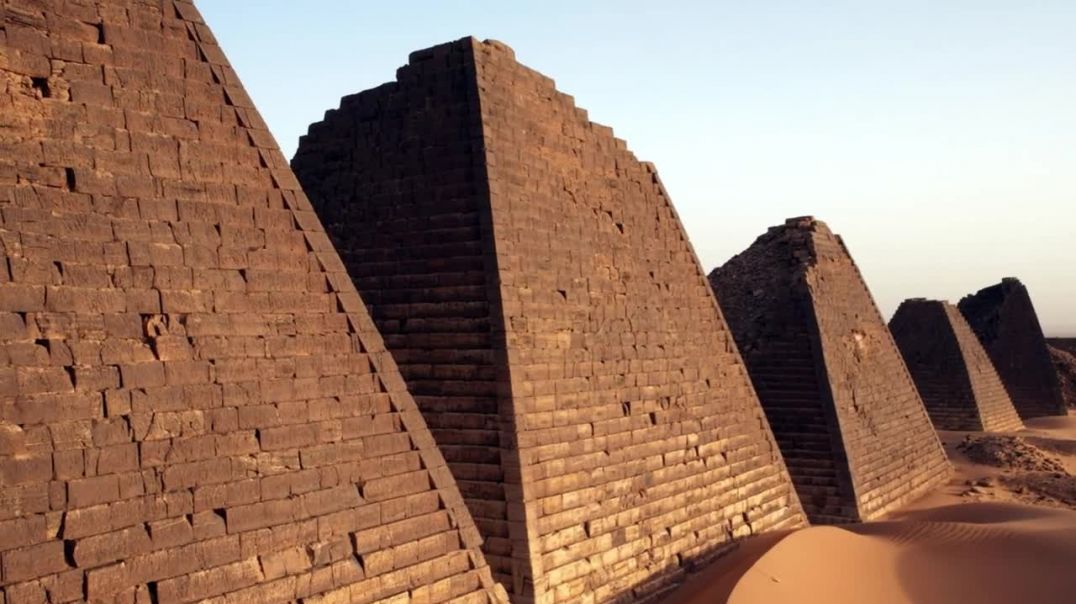

The story of Italian soldier turned treasure hunter Guiseppe Ferlini the infamous man known for destroying and robbing the great pyramids of Meroe in Sudan. In his quest to find gold that was said to be buried inside the Moertic pyramids, Ferlini dynamited multiple pyramids among them, the Pyramid of Queen Amanishakheto never finding gold.
See more: https://talkafricana.com/giuse....ppe-ferlini-the-trea


Ɔbenfo Manu Ampim and his Contra Costa College students presenting on unique classical African contributions to humanity in math, the high status of women, medicine, and astronomy. The presentation was given on February 24, 2021 during African Heritage Month ("Black History Month") before a Zoom audience of 230 people.In this presentation, the students are sharing what they have learned in Prof. Manu's unique course, A History of African Civilizations (Afram 210 / History 110). This is Ampim's book used for the course: https://advancingtheresearch.o....rg/product/a-history http://events.r20.constantcontact.com/register/event?llr=bxfdmskab&oeidk=a07ejjvp8z34b0af5c0&oseq=


Join Host Attorney Anthony Muhammad for The Business Hour Featuring special Guest Dr. Kamau Kambon
Listen to Sankofa Revolutionary Radio in Birmingham on FM 95.1 and online from anywhere you are.
Live at 9AM Eastern and
Rebroadcast at 3 PM and 6 PM
Listen to WSYP https://www.SankofaYDP.com
For More Info Visit www.KamauKambon.org
Special Interview. This coming Thursday, August 27, 2020
Learn about Black Liberation solutions to protect yourself and your family in this renewed brazen system of racism and white terror domination.
African School Theme SongMusic promoted by The Free Cat: http://tiny.cc/50cnpz
![Dr. Wangari Maathai - Unabridged Lecture at Concordia University 28 Sep 2009]](https://i.ytimg.com/vi/Pdxx0p8sls0/hqdefault.jpg)

Dr. Wangari Maathai is a Kenyan environmental, political activist and elected member of Parliament. She founded the Green Belt Movement, an environmental non-governmental organization focused on the planting of trees, environmental conservation, and women's rights. In 2004 she became the first African woman, and the first environmentalist, to receive the Nobel Peace Prize for her contribution to sustainable development, democracy and peace.
The world-renowned environmentalist shared her vision of change. She inspired students with stories of personal sacrifice and stressed that every single person can make a difference.
Maathais lecture was presented by the Concordia Student Union (CSU) in association with the Sustainability Action Fund, the Arts and Science Federation of Associations, the university and the Yves Rocher Foundation.
Find out more about the Green Belt Movement, Maathais forest conservation effort based in Nairobi, by visiting:
http://greenbeltmovement.org.
For information about the CSU Speaker Series, visit:
http://life.csu.qc.ca.
The video of the lecture was produced by Concordia University Television, Canada's oldest student-run television station:
http://cutv.concordia.ca/
http://www.youtube.com/cutv


Just a few decades ago, Ethiopia was a country defined by its famines, particularly between 1983-1985 when in excess of half a million people starved to death as a consequence of drought, crop failure and a brutal civil war.
Against this backdrop, in recent years, Ethiopia has been experiencing stellar economic growth. The headline statistics are certainly remarkable: the country is creating millionaires faster than any other in Africa; output from farming, Ethiopia’s dominant industry, has tripled in a decade; the capital Addis Ababa is experiencing a massive construction boom; and the last six years have seen the nation’s GDP grow by a staggering 108 percent.
But it is not all positive news.
Around 90 percent of the population of 87 million still suffers from numerous deprivations, ranging from insufficient access to education to inadequate health care; average incomes are still well below $1500 a year; and more than 30 million people still face chronic food shortages.
Many critics say that the growth seen in agriculture, which accounts for almost half of Ethiopia’s economic activity and a great deal of its recent success, is actually being driven by an out of control ‘land grab', as multinational companies and private speculators vie to lease millions of acres of the country’s most fertile territory from the government at bargain basement prices.
At the ministry of agriculture in Addis Ababa, this land-lease programme is often described as a "win-win" because it brings in new technologies and employment and, supposedly, makes it easier to improve health care, education and other services in rural areas.
"Ethiopia needs to develop to fight poverty, increase food supplies and improve livelihoods and is doing so in a sustainable way," said one official.
But according to a host of NGO’s and policy advocates, including Oxfam, Human Rights Watch and the Oakland Institute, the true consequences of the land grabs are almost all negative. They say that in order to make such huge areas available for foreign investors to grow foodstuffs and bio-fuels for export - and in direct contravention of Ethiopia’s obligations under international law - the authorities are displacing hundreds of thousands of indigenous peoples, abusing their human rights, destroying their traditions, trashing the environment, and making them more dependent on food aid than ever before.
The most controversial element of the government’s programme is known as 'villagisation' - the displacement of people from land they have occupied for generations and their subsequent resettlement in artificial communities.
In Gambella, where two ethnic groups, the Anuaks and the Nuers, predominate, it has meant tens of thousands of people have been forced to abandon a traditional way of life. One such is Moot, an Anuak farmer who now lives in a government village far from his home.
Despite growing internal opposition and international criticism, the Ethiopian government shows no sign of scaling the programme back. According to the Oakland Institute, since 2008, an area the size of France has already been handed over to foreign corporations. Over the next few years an area twice that size is thought to be earmarked for leasing to investors.
So what does all this mean for the people on the ground? In Ethiopia – Land for Sale, filmmakers Veronique Mauduy and Romain Pelleray try and find out.
Connect with People & Power:
YouTube - http://aje.io/peopleandpowerYT
Facebook - https://facebook.com/AJPeopleAndPower
Twitter - https://twitter.com/AJpeoplepower
Website - http://www.aljazeera.com/peopleandpower/
#AlJazeeraEnglish #People&Power #LandGrabs

#TheNewBlackMind
► Subscribe to Transatlantic Productions 💥Smash The LIKE Button👍🏿 Share↗️ & hit the Notifications Bell 🔔
► Donate so we can complete the upload https://www.gofundme.com/tapvideo
► Cash App: $Tapvideo $GodKingD91 $BrotherRonn $Moneymark0730
► Share on video on all Social Media.
► Website https://tapvideo.blogspot.com
https://www.facebook.com/Tapvi....deocom-7441435789873
► Back up Channels:
https://www.youtube.com/channe....l/UCs9-wRHfFb7v7RQAi
https://www.youtube.com/user/savejamaica