- General Videos
- Music
- Economics
- Health
- Travel & Events
- History
- Psychology
- Spirituality
- Movies
- News & Politics
- Kmtyw Combat Sciences
- Ɔbenfo Ọbádélé Kambon Videos
- Ɔbenfoɔ Kamau Kambon: Black Liberation Philosophy
- Science, Tech, Engineering and Math
- Permaculture
- Self-Sustainability
- Living Off Grid
- Yoruba Language Learning
- Education
- Mmɔfra Adesua
- Nana Kamau Kambon Playlist
- Livestream
- Komplementarity Kouples and Revolutionary Singles
- Abibitumi Film Series
- Decade of Our Repatriation
- Live
Top videos




![Green Wall: How to Green the Sahara [2020]](https://i.ytimg.com/vi/YQ_HCVo1Pig/hqdefault.jpg)


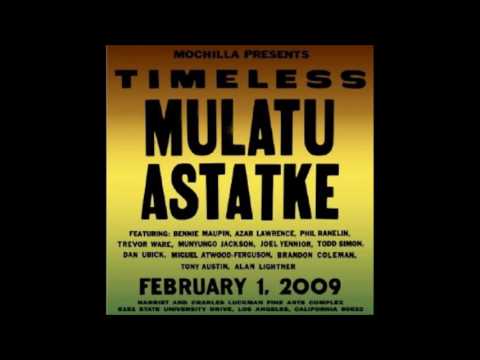
Funk-infused political statement. Afrobeat.
Artist: Fela and Afrika '70
Album: Zombie
Label: Coconut
Year: 1976
Tracklist:
0:00 Zombie
12:26 Mister Follow Follow
25:24 Observation is no Crime
38:50 Mistake
Personnel:
Composed, arranged and produced by Fela Anikulapo Kuti
Lyrics by Wole Kuboye
Artwork by Gharikwu Lemi
Fela Anikulapo Kuti - vocals, tenor saxophone, alto saxophone, piano
Lekan Animashaun - baritone saxophone
Nwokoma Ukem - trumpet
Tunde Williams - trumpet
B. Osuhor - voclas
F. Oladeinde - vocals
F. Oladejo - vocals
K. Oghomienor - vocals
O. Osaeti - vocals
R. Edasow - vocals
S. Komolafe - vocals
T. Adebiyi - vocals
Okalue Ojeah - guitar
Oghene Kologbo - tenor guitar
Nweke Atifoh - bass guitar
Ladi "Tony Allen" Alabi - drums
Ayoola Abayomi - claves
Babajide Olaleye - maracas
Addo Nettey - congas
Olandeinde Koffi - congas
Shina Abiodun - congas
Tracks 3 and 4 recorded live at The Berlin Jazz Festival (1978)
http://fela.net/
Support the artist if you like the music. I do not own any of the songs.




In this video, Juliet responds to 3 questions about Gambia as requested by www.forgambia.com. She explains why Gambia is the place to be!
Juliet mentions that reparations is due for slavery https://www.youtube.com/watch?v=5nWBp9Yg_8U&t=974s
Special thanks to Makonnen Sankofa (Bla Xit Cameraman and Video Editor). Subscribe to Makonnen's YouTube channel for more great content https://www.youtube.com/channe....l/UCiP8DHZ_eEFLJdOn7
Thanks to Stephanie Nwadiei and ThingsAfrica.com for their donations to the Bla Xit channel.
If you would like to support the channel so we can continue producing more content, you can send your donation via PayPal to bopcollective@yahoo.com
Become a Bla Xit Messenger (Subscribers only) by sending your video clip to blaxithome@gmail.com
Special thanks to our friend and YouTuber Wode Maya for helping to set-up the Bla Xit channel. You can follow him on YouTube too www.youtube.com/user/MrGhanaBabyyy
Please like, comment, share and subscribe!


I was Kyrie’d too! And it can happen to you!
Kyrie donates $500k to the ADL and Jews and STILL gets suspended?!
Kyrie is the latest Kapernik on down to Tommie Smith and Muhammad Ali.
This is about the suppression of information. The history between Afrikanz and so-called Jews is nothing new.
I was Kyrie’d too in 2017 losing my job because of what I post on my personal social media pages—during post work hours!
Like Ye and Kyrie, our ability to earn money—which allows us to live in this world—is determined by a paycheck we receive from a boss that can decide to fire you whenever they want and for whatever reason. The chess move is realizing If you allow someone to feed you, you also allow them to starve you!
The solution is to become financially educated. Working for someone isn’t the only way to “earn” a living.
Get smarter, join the @Cryptowoke Financial Sustainability Movement where you’ll learn how to live off your savings and investments.
Both your life and your bloodline depends on it!
Join the movement: http://cryptowokemovement.com
Your Financial Therapist,
M’Bwebe Ishangi
#IWasKyriedToo #Cryptowoke #FireYourBoss #FinancialTherapy #BlackFinancesMatter #FireYourBoss


#holiday, #celebration , #egypt, #thanksgiving
WHO TOLD YOU AND ENFORCES YOU TO CELEBRATE KWANZAA, CHRISTAMS, INDEPENCE DAYS OR EVEN THANKSGIVING?
• Do you know that Before the Romans and the Greeks, we had a 10-day week, kept by charting Stars, that were visible on our Calendar. All our sages, were AWARE of the Movement, of the Earth, Moon and Stars. Our Ancient Afrikan Primordial Ancestors were COSMICALLY Attuned, reconciled, aligned, coordinated, keyed, integrated, suited, adapted, harmonized; … All other calendars today disturb
• confuse
• skew
• disrupt
• upset
• disorder
• disharmonize
• alienate
YOUR Conscious awakening. So which days can we honestly call African Holy days not Holidays?
We suggest seven such days. Find them herein
Share Comment and SUBSCRIBE
References
https://www.eoht.info/page/Easter#:~:text=The day or month of,(Kendrenos%2C 1050AD)%2C therein
https://www.osirisnet.net/dieu....x/osiris/e_osiris_02

You Don't Know Black History Until You've Read 'Who IZ the Boulé?: The History of America's First Black Fraternity and the Derailment Toward Afrikan Self-Reliance'
In the spirit of Black History Month, we must not only celebrate the accomplishments of our people, but also the obstacles that's made inequality still relevant today so that we may not repeat the same mistakes.
As we trod forward for ensuing generations, this means activating your critical 3rd eye asking the most important question: “Why is it taking so long for Black people to progress?"
If we are to truly be free, there must be some internal house cleaning. What you'll find at the top of the chain is America's first Black Fraternity, Sigma Pi Phi aka the Boulé.
If you haven't read this book, YOU SHOULD! And if you've already read it, consider hearing the audiobook version or even gifting a copy for someone you know needs to know!
Why is this book so important to our history? Read here: http://daghettotymz.com/rkyvz/....articles/bouleseries
Get your copy in paperback, audiobook, or eBook at daghettotymz.com
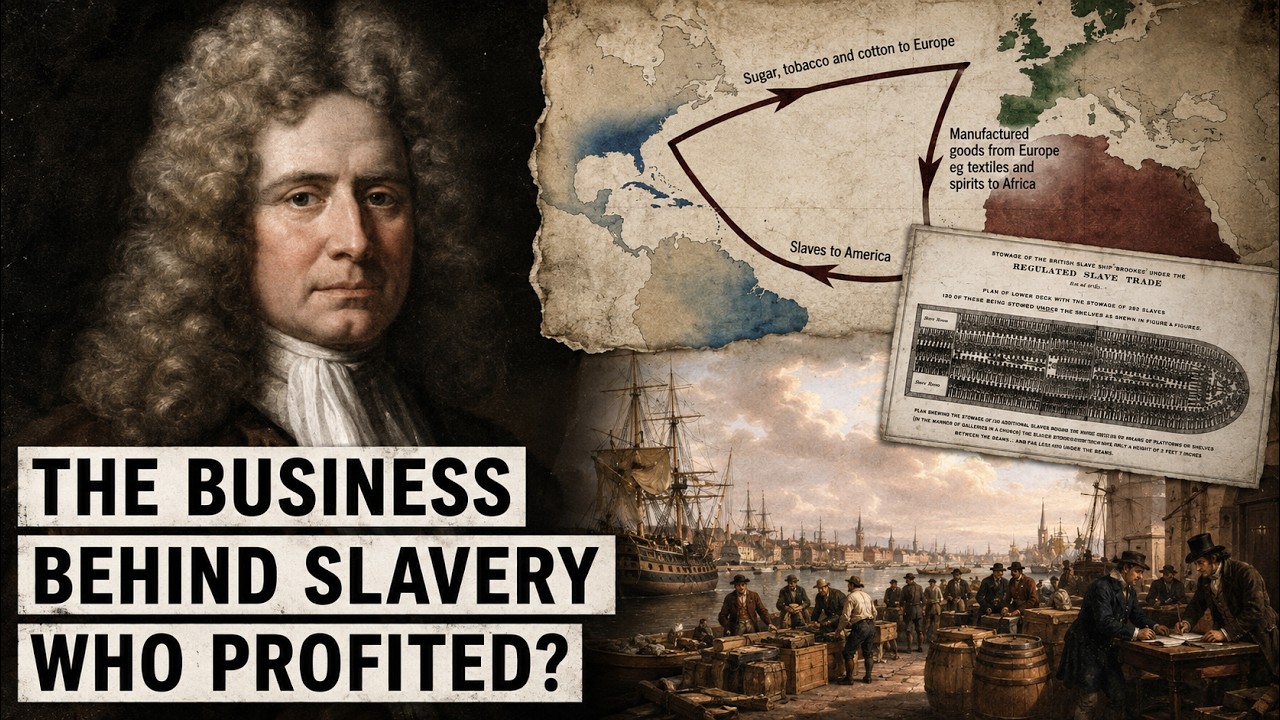

The Atlantic slave trade wasn't just a moral catastrophe — it was the most profitable business operation in human history. For over three centuries, a vast financial machine connected three continents, generating wealth that built cities, funded banks, bankrolled the Industrial Revolution, and created dynastic fortunes that are still compounding today.
In this video, we follow the money. From the Portuguese trading posts of the 1400s to the boardrooms of Lloyd's of London. From the sugar plantations of Jamaica, where enslaved workers had a life expectancy of seven years, to the grand townhouses of Liverpool, where merchant families lived in extraordinary luxury funded by human cargo. From the Royal African Company — a crown-backed corporation that branded enslaved people with its initials — to the Bank of England, whose early governors profited directly from the slave economy.
We examine the triangular trade not as a historical diagram, but as a fully integrated global financial system. We look at who invested, who insured, who extended credit, and who collected the dividends. We explore how slave trade profits became the seed capital for Britain's Industrial Revolution, how New England merchants ran closed-loop supply chains of rum, sugar, and enslaved people, and how the British government paid slave owners £20 million in compensation when slavery was abolished — a debt so large that British taxpayers were still paying it off in 2015.
This is the story of who really profited from the Atlantic slave trade, and why the financial architecture they built is still shaping the world today.
If you found this valuable, please like, subscribe, and share this video. It helps more than you know.
#atlanticslavetrade #slaveryandcapitalism #whoreallyprofited #triangulartrade #slavetradeeconomics #royalafricancompany #lloydsoflondon #britishempire #sugarplantations #industrialrevolution #ericwilliams #capitalismandslavery #liverpool #bristol #middlepassage #slavetradehistory #colonialwealth #economichistory #hiddenhistory #moneyandpower #macrofinance #globaleconomics


We are happy to welcome Bevin Magama to 'Africanus Talks' to discuss his passion for professional storytelling and writing. Bevin travels extensively around the UK and internationally conducting themed storytelling workshops alongside his own live performances. In both schools and workplaces, Bevin's wealth of knowledge about 'Storytelling' as more than just an art form, but a cultural backbone much needed within Africanus communities is exhaustive. Bevins skills allow him to use storytelling to challenge bullying in workplaces, conflict resolution, while still creating a safe environment renowned for being fun, building confidence, improving literacy and oracy in schools. We hope you enjoy this introspective interview from our brother Bevin Magama!
Bevin Magama Socials & Websites
Website - http://bevinmagama.com/
Twitter - https://twitter.com/bevin_magama
Facebook - https://www.facebook.com/StorytellerM...
YouTube - https://www.youtube.com/channel/UCFfv...
Website - www.Africanusworld.com
Pateron - https://www.patreon.com/AfricanusWorld
Facebook - https://www.facebook.com/AfricanusWorld/
Twitter - https://twitter.com/AfricanusWorld
Instagram - https://www.instagram.com/aricanusworld/
Pay Pal - https://www.paypal.com/cgi-bin/webscr...