- General Videos
- Music
- Economics
- Health
- Travel & Events
- History
- Psychology
- Spirituality
- Movies
- News & Politics
- Kmtyw Combat Sciences
- Ɔbenfo Ọbádélé Kambon Videos
- Ɔbenfoɔ Kamau Kambon: Black Liberation Philosophy
- Science, Tech, Engineering and Math
- Permaculture
- Self-Sustainability
- Living Off Grid
- Yoruba Language Learning
- Education
- Mmɔfra Adesua
- Nana Kamau Kambon Playlist
- Livestream
- Komplementarity Kouples and Revolutionary Singles
- Abibitumi Film Series
- Decade of Our Repatriation
- Live
Top videos


Let's Get Free:
Buy/Listen - https://lnk.to/letsgetfree!ythh
About the album:
Let's Get Free is the debut studio album by hip-hop duo, dead prez. Critically acclaimed upon its release, Let's Get Free was called a "return to politically conscious rap" and "the most politically conscious rap since Public Enemy."
Follow dead prez:
Spotify - https://lnk.to/letsgetfreeSp!ythh
YouTube - https://lnk.to/letsgetfreeAY!ythh
#DeadPrez #HipHop #Vevo


In this week's episode of Powered by Nyame, our topic is magic and the magical world we have and perhaps ought to live in. The modern world is but one version of reality, an artificial one at that. In spite of its seductive allure, of gadgets, devices, and virtual everything, it lacks a soul and remains without a guiding spirit. Making better machines is no substitute for making better human beings. The magical world of the ancients still exist, if we are receptive to it and the human impossibilities it makes possible.
This episode marks our one year anniversary. Please consider joining this channel to get access to perks:
https://www.youtube.com/channe....l/UCykQ4Bi0UQj7LcL-2
![PART I - The Fulani in Nigeria: The Land War I AFP [26 July 2019]](https://i.ytimg.com/vi/VXvXPkwFq7g/hqdefault.jpg)






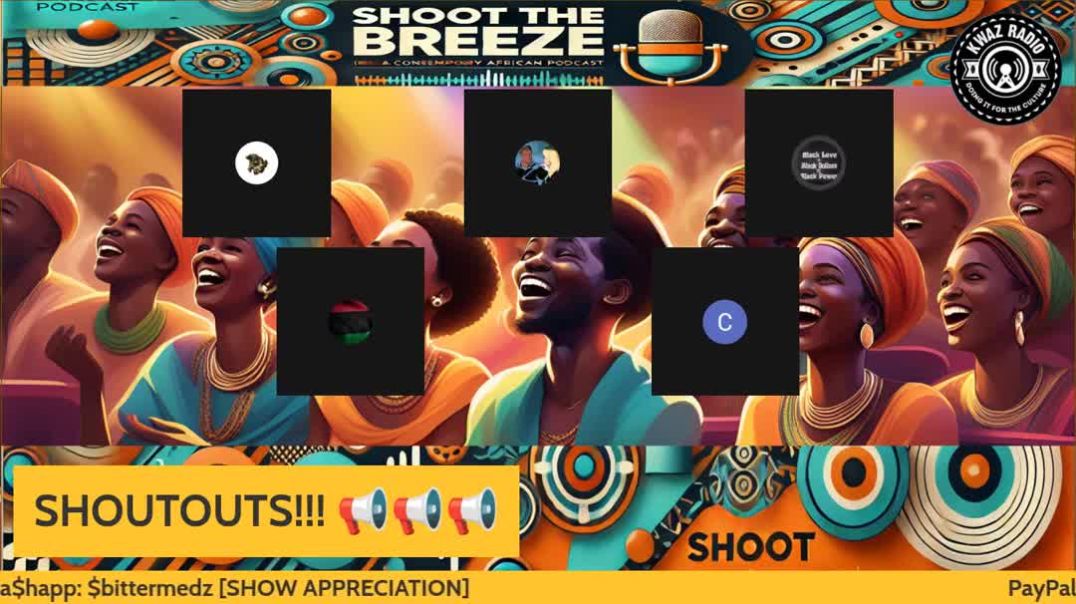

🎙 From Shoot the Breeze on the Bitter Medicine Podcast.
Does money make some Black people think they’re above other Black people? 💰🌍 The panel connects capitalism to diaspora hierarchy.
Watch the full episode here: https://youtube.com/live/Hx_AOjFsb2E
Drop your thoughts below 👇🏾
Subscribe for Pan-African talk, Black empowerment, and nation-building. 🔔


![Mhenga Malcolm X: Speech | Q & A - University of California Berkeley [1963]](https://i.ytimg.com/vi/DK9bbDxWrOs/hqdefault.jpg)
![Awet Nhafash: Victory to the Masses [1991] P4/4]](https://i.ytimg.com/vi/sfiNvj64NAQ/hqdefault.jpg)
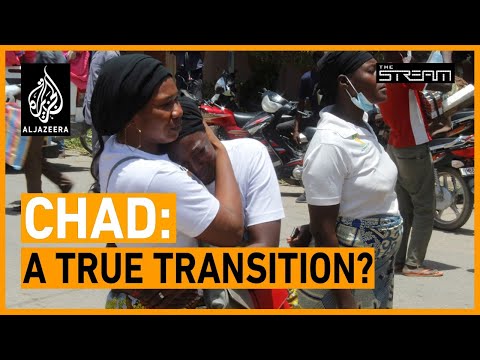

More than thirty years of increasingly repressive rule by one man in Chad has in recent weeks given way to sudden political uncertainty, as first an unappointed military council and now a transitional government reckon with the country’s future in the wake of President Idriss Deby’s unexpected death.
Chad’s interim president Mahamat Deby – son of Idriss – on May 2 named a 40-member transitional government after days of widespread popular discontent over power being concentrated within a 15-member Transitional Military Council (CMT), led by Deby.
While some opposition leaders have joined the new transitional government, the majority of ministerial posts were reserved for members of Deby’s Patriotic Salvation Movement (MPS). And there is simmering public discontent that parliament was dissolved and the constitution suspended before the CMT was formed. While parliament reconvened this week, one opposition leader says Chad is still being denied a full transition to civilian rule.
In this episode of The Stream, we’ll look at what lies ahead for people in Chad as it adjusts to life without Idriss Deby.
Join the conversation:
TWITTER: https://twitter.com/AJStream
FACEBOOK: http://www.facebook.com/AJStream
Subscribe to our channel http://bit.ly/AJSubscribe
#aljazeeraenglish
#ajstream
#chad
![Dr. Martin Luther King Jr.: The Three Evils of Society - War, Racism and Poverty [1967]](https://i.ytimg.com/vi/6sT9Hjh0cHM/hqdefault.jpg)

Amilcar Cabral and the Liberation Struggle: Education as the Corners for Revolution
Join militant historian Sónia Vaz Borges for a lecture on the revolutionary struggle of the PAIGC and life and legacy of Amilcar Cabral.
“The people of ‘Portuguese’ Guinea took up arms to free their country from colonial domination in 1963, under the leadership of the Partido Africano da Independencia da Guiné e Cabo Verde (PAIGC). Amilcar Cabral, the founder of the PAIGC, saw the necessity of freeing their country from Portuguese colonial domination. The experiences of other liberation movements, the growth of neo-colonialism in the newly ‘independent’ African countries, and above all the development of the movement within Guinea itself made clear the necessity of a true socialist revolution if any real change was to be made.
To revolutionary movements throughout the world, the struggle in Guinea is of prime importance as an outstanding illustration of the need to study one’s own concrete conditions and to make the revolution according to these conditions, rather than relying on the experience of others, valuable as this may be.”
-From Amilcar Cabral – Revolution in Guinea Bissau. An African People’s Struggle. London: Stage 1. 1969
Sónia Vaz Borges is a militant interdisciplinary historian, social and political organizer. She has B.A. in Modern and Contemporary History, Politics and International Affairs from ISCTE -University Institute of Lisbon, and a M.A. in African History from the Faculty of Humanities of the University of Lisbon. She received her Ph.D. in Philosophy from Humboldt University of Berlin, and a postdoctoral from the Center for Place, Culture and Politics (CPCP) at the Graduate Center City University of New York. She is also the editor of the booklets Cadernos Consciência e Resistência Negra (2007-2011) and author of the book Na Pó di Spéra. Percursos nos Bairros da Estrada Militar, Santa Filomena e Encosta Nascente (2014). Along with filmmaker Filipa César, Sónia Vaz Borges co-authored the short film Navigating the Pilot School (2016). Sónia Vaz Borges lives in Berlin and is a researcher at the Humboldt University of Berlin, and its currently working on a new project and a second film together with Filipa César.
For readings and study materials, go to: https://politicaleducation.peo....plesforum.org/lectur