Top videos

⁣"Africans Sold Africans into Slavery" and Other Fairy Tales that Keep 'white' P
⁣"Africans Sold Africans into Slavery" and Other Fairy Tales that Keep 'white' P Ọbádélé Kambon 6 Views • 2 years ago

⁣"Africans Sold Africans into Slavery" and Other Fairy Tales that Keep 'white' People Safe Live Presentation – April 26, 2025 @ 7:00 PM GMT Online via Abibitumi Platform Cut through the lies. Rebuild the truth. This isn’t just a presentation—it’s a precise dismantling of the deliberately crafted myth that “Africans sold Africans into slavery.” A myth designed to protect ‘white’ people from retribution, obscure historical fact, and divide Black people through confusion and misdirection so that we stay in the fragment vs. fragment state that got us in this situation in the first place. Join Ɔbenfo (Professor) Ọbádélé Kambon for a rigorous, documented, and unapologetic exposé that reframes the conversation using primary sources, linguistic insight, historical documentation, and cultural logic. What You’ll Learn: Why the phrase “Africans sold Africans” is historically false and anachronistic—no one called themselves “African” at the time, and even the name Africa is a Latin exonym, not an indigenous term (The Latin suffix -ica (as in Africa, America, Corsica, Antarctica) attests to the foreignness of the word) How the transatlantic Maangamizi began in 1441 with direct raids and kidnappings by "whites"—not buying and selling Why resistance sites like Gwollu, Nzulenzu, and Ganvié give material proof that people who didn't see themselves as "Africans" were building to defend themselves against "white" kidnappers and others who didn't see themselves as "Africans" The full extent of "white" involvement: raiders, financiers, sellers, insurers, shipbuilders, religious justifiers, legal architects, arms suppliers, and more - If one can't return home because "Africans" sold them, how can they stay in places like amerikkka where "whites" sold them, bought them, developed religious and pseudoscientific justifications, lynched them, and committed and continue to commit every other imaginable atrocity? Why the narrative persists: because it keeps ‘white’ people safe from retribution, while encouraging Abibifoɔ 'Black People' to turn on each other -- just as we did during internecine kidnapping and raiding Registration Includes: Live access to the presentation on April 26, 2025 @ 7:00 PM GMT Private access link via Abibitumi Live Q&A session with Professor Ọbádélé Kambon Ability to connect with others serious about Abibifahodie (Black Liberation) This is not a sanitized history lesson. It’s a weaponized presentation for those who are ready to throw off confusion and deal with truth at the highest level. Register now. Reject the fairy tale. Prepare for retribution.

Ọbádélé Kambon, PhD: Why Kemet (Ancient Egypt) Matters
Ọbádélé Kambon, PhD: Why Kemet (Ancient Egypt) Matters Ọbádélé Kambon 5 Views • 6 years ago

Afrikan Renaissance Foundation (ARF)
13 October, 2015
Archaeology Department
University of Ghana - Legon

Abstract:
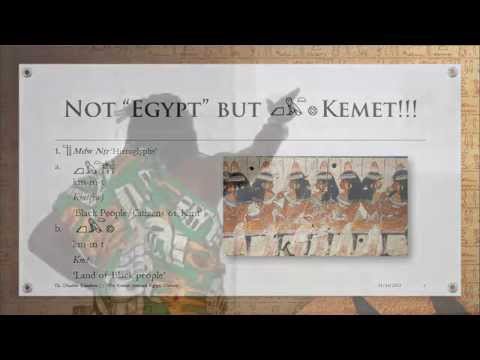
Abstract: Did you know that Afrikan/Black people invented writing? Were you aware that the oldest book in the history of humanity was written by an Afrikan in Kmt ‘Land of Black People’ contemporarily known as Ancient Egypt? In this presentation we will provide examples that clearly show that Math, Science, Medicine, Architecture, History, Philosophy, Politics, Spirituality, Warfare and Combat Sciences, Agricultural Science, Astronomy, Culture, Cosmology, Literature, and other Arts were first developed in Kmt ‘Land of Black People’ (so-called Ancient Egypt) just to name a few. Did you know that the people of so-called “Ancient Egypt” did not refer to themselves as “Egyptians” but referred to themselves as Kmt(yw) ‘Black People?’ Were you aware that a series of DNA tests done by geneticists in 2012 and 2013 shows that the closest genetic relatives to the ancient Rulers (Pharoahs) of Kemet are now located in Southern Afrika, the Great Lakes Region of Afrika and Tropical West Afrika followed by the Sahel and the Horn of Afrika? This means that the Kmt(yw) ‘Black People’ of ancient times were your ancestors and you are their descendants. Were you aware that the white arab-types currently found in modern-day Egypt are comparatively recent invaders whose genetic relation to the Afrikan/Black people of Ancient Kmt ‘Land of Black People’ is further away than the distance from Cairo to Cape Town? In this talk we will highlight information known by Afrikans and non-Afrikans throughout the world but which has been systematically and intentionally kept from us through purposive miseducation, dis-education and outright lies. Why were we not told of this information? In this talk, we will build on the work of great scholars such as Cheikh Anta Diop to begin to scratch the surface of the legacies of Kmt ‘Land of Black People’ and discuss the implications of the ongoing systematic and intentional disinformation campaign in the context of the theme Why Kemet Matters.

Uganda's Health Pyramid | People & Power | 2 Feb 2017
Uganda's Health Pyramid | People & Power | 2 Feb 2017 Ambakisye-Okang Dukuzumurenyi 14 Views • 6 years ago

Living in a poor country with one of the worst doctor-patient ratios in the world - about one for every 24,000 people - it's perhaps no surprise that many Ugandans are tempted by alternative remedies, even though there's often little evidence to support the claims made about their efficacy in treating or preventing disease. But the phenomenon does beg many questions, not least of which are who is really benefiting from the sale of these products and how exactly are they marketed?

We'd heard reports about one particularly controversial business, a complex multi-level marketing scheme run in Uganda under the aegis of a Chinese company called Tiens, which produces food supplements.

Its products, we'd been told, were being inappropriately sold as medications - in some cases for very serious diseases. We had also heard disturbing claims that its sales representatives, or "distributors" as they are known, were being invited to invest large sums of money in Tiens products, when in reality there was little chance of most of them ever making the kind of dazzling returns that the company promised.

So we sent a filmmaking team and Ugandan reporter Halima Athumani to investigate further.

- Subscribe to our channel:
http://aje.io/AJSubscribe
- Follow us on Twitter: https://twitter.com/AJEnglish
- Find us on Facebook: https://www.facebook.com/aljazeera
- Check our website: http://www.aljazeera.com/

Showing 496 out of 497