Top videos

The Touaregs in Their Country (1908) | Silent Film
The Touaregs in Their Country (1908) | Silent Film Ambakisye-Okang Dukuzumurenyi 35 Views • 5 years ago

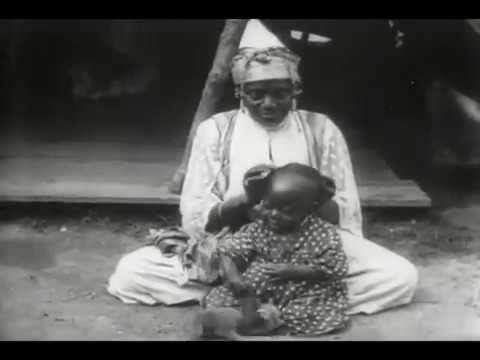
Presented for historical reference.French title, Chez les TouaregsScenes of a Touareg village show the tribe's women, boys posing and fighting, two men fighting with sticks and wrestling, the tying of a turban, equipping and mounting the camels, the parade of a caravan, demonstrating an assault on a colonial courier, a "Fantasia" parade, horsemen riding toward the camera with their guns blazing, and a mother and child playing with a kitten. From the US Library if Congress.“The Tuareg people (/ˈtwɑːrɛɡ/; also spelt Twareg or Touareg; endonym: Kel Tamasheq, Kel Tagelmustare a large Berber ethnic confederation. They principally inhabit the Sahara in a vast area stretching from far southwestern Libya to southern Algeria, Niger, Mali and Burkina Faso. Traditionally nomadic pastoralists, small groups of Tuareg are also found in northern Nigeria.The Tuareg speak the Tuareg languages (also known as Tamasheq), which belong to the Berber branch of the Afroasiatic family.The Tuaregs have been called the "blue people" for the indigo-dye coloured clothes they traditionally wear and which stains their skin. A semi-nomadic Muslim people, they are believed to be descendants of the Berber natives of North Africa. The Tuaregs have been one of the ethnic groups that have been historically influential in the spread of Islam and its legacy in North Africa and the adjacent Sahel region.Tuareg society has traditionally featured clan membership, social status and caste hierarchies within each political confederation. The Tuareg have controlled several trans-Saharan trade routes and have been an important party to the conflicts in the Saharan region during the colonial and post-colonial era.” — Wikipedia

Black Wall Street Tulsa, OK 1921 Pt 1
Black Wall Street Tulsa, OK 1921 Pt 1 Angela Malele 35 Views • 5 years ago

The point of uploading this to spread this information across US, but also the entire globe for the world to recognize one of the greatest tragedies that has ever taken place in this country.

88 Years Since The Destruction and Massacre of Greewood, Tulsa AKA Black Wall Street

The date was June 1, 1921 when "BLACK WALLSTREET", the name fittingly given to one of the most affluent all-BLACK communities in America , was bombed from the air and burned to the ground by mobs of envious whites. In a period spanning fewer than 12 hours, a once thriving Black business district in northern Tulsa lay smoldering--a model community destroyed and a major African-American economic movement resoundingly defused.

The night's carnage left some 3,000 African Americans dead and over 600 successful businesses lost. Among these were 21 churches, 21 restaurants, 30 grocery stores and two movie theaters, plus a hospital, a bank, a post office, libraries, schools, law offices, a half dozen private airplanes and even a bus system. As could have been expected, the impetus behind it all was the infamous Ku Klux Klan, working in consort with ranking city officials and many other sympathizers.

.. The best description of BLACK WALLSTREET, or little Africa as it was also known, would be to compare it to a mini-Berverly Hills. It was the golden door of the BLACK community during the early 1900s, and it proved that African Americans could create a successful infrastructure. That's what BLACK WALLSTREET was all about.

The dollar circulated 36 to 100 times, sometimes taking a year for currency to leave the community. Now a dollar leaves the BLACK community in 15-minutes. As far as resources, there were Ph.D.'s residing in little Africa , BLACK attorneys and doctors. One doctor was Dr. Berry who owned the bus system. His average income was $500 a day, a hefty pocket change in 1910.

It was a time when the entire state of Oklahoma had only two Airports, yet six BLACKS owned their own planes. It was a very fascinating community. The mainstay of the community was to educate every child. Nepotism was the one word they believed in. and that's what we need to get back to.

The main thoroughfare was Greenwood Avenue , and it was intersected by Archer and Pine Streets. From the first letters in each of those three names you get G.A.P. and that's where the renowned R and B music group the GAP Band got its name. They're from Tulsa .

BLACK WALLSTREET was a prime example of the typical, BLACK community in America that did businesses, but it was in an unusual location. You see, at the time, Oklahoma was set aside to be a BLACK and Indian state. There were over 28 BLACK townships there. One third of the people who traveled in the terrifying "Trail of Tears" along side the Indians between 1830 and 1842 were BLACK people.

The citizens of this proposed Indian and BLACK state chose a BLACK governor, a treasurer from Kansas named McDade. But the Ku Klux Klan said that if he assumed office that they would kill him within 48 hours. A lot of BLACKS owned farmland, and many of them had gone into the oil business. The community was so tight and wealthy because they traded dollars hand-to-hand, and because they were dependent upon one another as a result of the Jim Crow Laws.

It was not unusual that if a resident's home accidentally burned down, it could be rebuilt within a few weeks by neighbors. This was the type of scenario that was going on day-to-day on BLACK WALLSTREET. When BLACKs intermarried into the Indian culture, some of them received their promised '40 acres and a mule' and with that came whatever oil was later found on the properties.

On BLACK WALLSTREET, a lot of global business was conducted, the community flourished from the early 1900s until June 1, 1921. That's when the largest massacre of nonmilitary Americans in the history of this country took place, and it was lead by the KU KLUX KLAN. Imagine walking out of your front door and seeing 1,500 homes being burned. It must have been amazing.

Showing 630 out of 631