Top videos

What Happens When Maths Goes Wrong? - with Matt Parker
What Happens When Maths Goes Wrong? - with Matt Parker Ambakisye-Okang Dukuzumurenyi 31 Views • 5 years ago

Most of the time, the maths in our everyday lives works quietly behind the scenes, until someone forgets to carry a '1' and a bridge collapses or a plane drops out of the sky.
Subscribe for regular science videos:
http://bit.ly/RiSubscRibe

Matt's book "Humble Pi" available now: https://geni.us/9nPhpn3

Matt Parker is a stand-up comedian and mathematician. He appears regularly on TV and online: as well as being a presenter on the Discovery Channel. His YouTube videos have been viewed over 37 million times. Previously a high-school mathematics teacher, Matt visits schools to talk to students about maths as part of Think Maths and he is involved in the Maths Inspiration shows. In his remaining free time, Matt wrote the books Things To Make and Do in the Fourth Dimension and Humble Pi: A Comedy of Maths Errors. He is also the Public Engagement in Mathematics Fellow at Queen Mary University of London.

This talk was filmed in the Ri on 1 March 2019.

---
A very special thank you to our Patreon supporters who help make these videos happen, especially:
bestape, Dave Ostler, David Lindo, Greg Nagel, Ivan Korolev, John Pollock, Lester Su, Osian Gwyn Williams, Radu Tizu, Rebecca Pan, Robert Hillier, Roger Baker, Sergei Solovev, and Will Knott
---

The Ri is on Patreon: https://www.patreon.com/TheRoyalInstitution
and Twitter: http://twitter.com/ri_science
and Facebook: http://www.facebook.com/royalinstitution
and Tumblr: http://ri-science.tumblr.com/
Our editorial policy: http://www.rigb.org/home/editorial-policy
Subscribe for the latest science videos: http://bit.ly/RiNewsletter

Product links on this page may be affiliate links which means it won't cost you any extra but we may earn a small commission if you decide to purchase through the link.

Yusef Doucet: Una Historicidad Cultural Africana: Escapando de la Trampa
Yusef Doucet: Una Historicidad Cultural Africana: Escapando de la Trampa CEADA 31 Views • 5 years ago

El Ciclo de Conferencias de Estudios Africanos y de la Diáspora Africana, ha sido creado para difundir el pensamiento Africano-centrado y PanAfricanista a través de las experiencias y los aportes de los Africanos y sus descendientes alrededor de mundo. Es un espacio abierto y permanente, donde se invitan expertos en diferentes áreas del conocimiento y donde el dialogo circunda en temas de interés colectivo y desde la perspectiva centrada en África, panafricana y anti-colonial.

Una Historicidad Cultural Africana: Escapando de la Trampa.

Los archivos históricos son un recuento de la historia, pero la versión que promueven no está tan cuestionada como debería ser. Las nuevas perspectivas y la promoción de miradas diversas son fundamentales para ayudar a redefinir el papel de la historia en la sociedad contemporánea. En su ensayo "Un extraño en la aldea", James Baldwin escribió "la gente está atrapada en la historia y la historia está atrapada en ellos." Allí, relata la experiencia de ser una persona negra en un pueblo de blancos en Suiza a principios de la década de 1950. Ahora imagine el mismo ensayo escrito por un escritor suizo blanco que relata la experiencia de un hombre negro en su aldea.

Los archivos capturan la historia en la medida en que consagran las perspectivas de quienes han tenido el privilegio de contarla y escribirla. Bajo el colonialismo, la historia está colonizada; es estar atrapados en la historia de otra persona (Arundhati Roy). La línea de tiempo histórica del colonizador se convierte en la línea de tiempo universal y lo que se da por sentado de eras y edades. ¿De quién es la prehistoria? ¿De quién es la antigüedad? ¿De quién es la Edad Media? ¿De quién es la modernidad? Yusef Doucet presenta una Historicidad Cultural Africana y nos invita a desafiar el estado monolítico unilateral de los anales de la historia, pero sobre todo, a escapar de su trampa.

Conferencista: Yusef Doucet

[ENGLISH]

The Cycle of Conferences on African and the African Diaspora Studies [CEADA] invites to the conference “An African Cultural Historicity: Breaking Out the Trap” presented by Yusef Doucet.

The Cycle of Conferences on African and the African Diaspora Studies has been created to disseminate Afrocentric and Pan-Africanist thought through the experiences and contributions of Africans and their descendants worldwide. It is an open and permanent space where experts in different areas of knowledge are invited. The dialogue revolves around issues of collective interest and from the Afrocentric, Pan-Africanist, and anti-colonialist perspectives.

An African Cultural Historicity: Breaking Out the Trap.

The historical archives are a retelling of history, but the version they promote is not as questioned as it should be. New perspectives and the promotion of diverse points of view are critical to helping redefine the role of history in contemporary society. In his essay "Stranger in the Village," James Baldwin wrote, "people are trapped in history, and history is trapped in them." He recounts the experience of being black in a white village in Switzerland in the early 1950s. Now imagine the same essay written by a white Swiss writer recounting the experience of a black man in his village.

Archives capture history to the extent that they enshrine the perspectives of those who have had the privilege of telling and writing it. Under colonialism, history is colonized; it is being trapped in someone else's story (Arundhati Roy). The historical timeline of the colonizer becomes the universal and taken-for-granted timeline of eras and ages. Whose Pre-history? Whose antiquity? Whose Middle Ages? Whose modernity? Yusef Doucet presents African Cultural Historicity and invites us to challenge the one-sided monolithic state of the annals of history, but above all, to escape its trap.

Lecturer: Yusef Doucet.

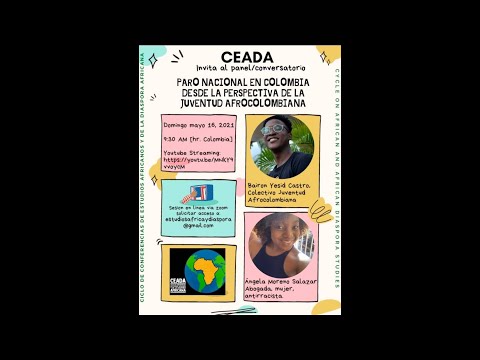
Paro Nacional en Colombia Desde La Perspectiva de la Juventud Afrocolombiana
Paro Nacional en Colombia Desde La Perspectiva de la Juventud Afrocolombiana CEADA 31 Views • 5 years ago

English:
In the framework of the national strike in Colombia, the black population, unlike the rest, has suffered the most drastic consequences. Although it is understood that the different reforms are of general affectation, Afro-Colombians have had to suffer it as an additional, in that although they already subject us to structural racism, we are the ones who put the dead when resisting a government nefarious, they are the black mothers who cry their children when they raise their voices and express their disagreement. A government that does not take us into account but only on paper to say internationally that Colombia is a multicultural and diverse country, as if only the existence of our people were enough, invalidating their needs and requirements for a dignified life.

Skip to the following parts for the parts in English and Creole (San Andres):
1. 20:00 to 29:34
2. 52:46 to 59:41
3. 2:37:18 to 2:51:47
4. 3:14:34 to 3:16:36


Español:
En el marco del paro nacional en Colombia, la población negra a diferencia de los demás, ha sido los que más consecuencias drásticas ha sufrido. Si bien se entiende que las diferentes reformas son de afectación general, a los afrocolombianls nos ha tocado sufrirla como un adicional, en que sí bien ya nos someten al racismo estructural, somos los que ponemos los muertos a la hora de poner resistencia a un gobierno nefasto, son las madres negras que lloran sus hijos cuando estos alzan la voz y expresan su inconformidad. Un gobierno que no nos tiene en cuenta sino solamente en papel para decir internacionalmente que Colombia es un país multicultural y diverso, cómo si solo la existencia de nuestra gente fuese suficiente, invalidando sus necesidades y requerimientos para una vida digna.

Showing 700 out of 701