- General Videos
- Music
- Economics
- Health
- Travel & Events
- History
- Psychology
- Spirituality
- Movies
- News & Politics
- Kmtyw Combat Sciences
- Ɔbenfo Ọbádélé Kambon Videos
- Ɔbenfoɔ Kamau Kambon: Black Liberation Philosophy
- Science, Tech, Engineering and Math
- Permaculture
- Self-Sustainability
- Living Off Grid
- Yoruba Language Learning
- Education
- Mmɔfra Adesua
- Nana Kamau Kambon Playlist
- Livestream
- Komplementarity Kouples and Revolutionary Singles
- Abibitumi Film Series
- Decade of Our Repatriation
- Live
Top videos
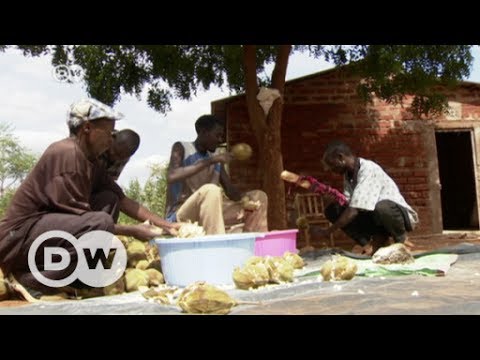

The fruit of the baobab tree has been eaten for centuries in Africa, but has only recently gained the coveted status of superfood due to its high content of vitamins and nutrients. In Kenya, it has become an economic force to be reckoned with.
For a related story, go to: http://p.dw.com/p/2azDo


Al Jazeera’s Investigative Unit secretly films officials in Namibia demanding cash in exchange for political favours. It’s a story of how foreign companies plunder Africa’s natural resources. Using confidential documents provided to Al Jazeera by Wikileaks, . “Anatomy of a Bribe” exposes the government ministers and public officials willing to sell off Namibia’s assets in return for millions of dollars in bribes. Al Jazeera journalists spent three months undercover posing as foreign investors looking to exploit the lucrative Namibian fishing Industry. The country’s Minister of Fisheries is shown willing to use a front company to accept a $200,000 ‘donation’. Exclusive testimony from a whistleblower who worked for Iceland’s largest fishing company reveals that his employers instructed him to bribe ministers and even the president in return for fishing rights worth hundreds of millions of dollars.
Subscribe to our channel http://bit.ly/AJSubscribe
Follow us on Twitter https://twitter.com/AJEnglish
Find us on Facebook https://www.facebook.com/aljazeera
Check our website: http://www.aljazeera.com/
#Aljazeeraenglish
#News

Last December, an Al Jazeera network investigation examined shocking claims that the government of Kenya has been running secret police death squads, tasked with assassinating suspected terrorists and criminals. At the time the Kenyan government strongly refuted the allegations but reports and rumours in Kenya about extra-judicial killings have continued to proliferate.
Ten months on, People and Power asked Mohammed Ali, one of Kenya’s top independent investigative journalists, to find out why.
In this deeply worrying film, Ali discovers that mysterious killings are indeed continuing amid a culture of apparent impunity, leaving Kenyan security forces open to suspicions that they are unaccountable and seemingly out of control.
He discovers that over 1,500 Kenyan citizens have been killed by the police since 2009, and that statistically, Kenyans are currently five times more likely to be shot by a policeman than a criminal.
With often little or no investigation by the Kenyan state into the circumstances surrounding these deaths, he finds evidence to suggest that an increasing number of Kenyan police officers may be complicit in what have been described as summary executions of suspects.
Even the Kenyan army, seen by most Kenyans as less corrupt and more trustworthy than the police, is now allegedly implicated in the torture and forced disappearance of terror suspects in the country’s northeastern region.
This film contains graphic images of violence and its aftermath that some viewers may find disturbing.
Connect with People & Power:
YouTube - http://aje.io/peopleandpowerYT
Facebook - https://facebook.com/AJPeopleAndPower
Twitter - https://twitter.com/AJpeoplepower
Website - http://www.aljazeera.com/peopleandpower/

Film by Nidhi Dutt and Daniel Boaden
People & Power investigates the environmental consequences of palm oil plantations in equatorial Africa.
There are few products so ubiquitous as palm oil. You can find its derivatives in chocolate, shampoo, toothpaste, detergent, ice cream, floor polish and a host of other products filling supermarket shelves.
Extracted from the fruit of the tropically-grown oil palm tree (Elaeis guineensis), it has become so versatile and sought after that the growing economies of Indonesia and Malaysia, the world's two largest producers, make some $40bn a year from its production and export.
Given that by 2020 global demand for palm oil is expected to double and then triple by 2050, it is no wonder that other developing countries, especially in sub-Saharan West Africa where the tree originates, have been looking enviously at Southeast Asia and hoping to emulate that success.
But palm oil cultivation does not come cost-free. If not done sustainably, say conservationists, it can have disastrous consequences for people and the environment. In Indonesia, for example, it has played a major role in deforestation which has seen the loss of more than 6 million hectares of primary forest over the last 15 years.
As rainforests are home to least half of this planet's species of plants, animals and insects, the negative impact on global biodiversity can only be imagined. In addition, indigenous communities are also destroyed as people who have lived happily off the forest's resources for generations, often do not own the land (at least not in a form recognised by governments, corporations and their lawyers) and are frequently displaced to make way for new plantations.
Boosting Cameroon's economy
It is against this background that the Central and West African state of Cameroon has been trying to get a palm oil industry off - or rather into - the ground. Its President Paul Biya, who has held office since 1982, has been looking for ways to give Cameroon's economy a boost.
His country is not as poverty-stricken as some on the continent. It has some modest oil resources and favourable conditions for agriculture and is comparatively stable politically, but it is not immune from many of the problems associated with developing nations, from chronically high unemployment and an inequitable distribution of income to corruption and inadequate public infrastructure.
Cameroon is also over-reliant on imports, which makes it susceptible to rising prices and food insecurity. According to the UN, more than 40 percent of the population are living under the poverty line, while over one-third of its children are suffering from chronic malnutrition.
Palm oil then, would seem to offer good prospects for additional growth. The tree is native to the region and the climate is perfect for its cultivation. And of course, there are plenty of international agribusiness conglomerates looking for suitable places in West Africa in which to replicate the stellar profits enjoyed by the industry in Asia.
More on our website: http://aljazeera.com
Follow us on Twitter: http://twitter.com/AJEngligh
Subscribe to our channel: http://bit.ly/AJSubscribe
Find us on Facebook: http://facebook.com/aljazeera
#AlJazeeraEnglish #PeopleandPower #Cameroon


#drmaat #mothers #mothersday #ittakesavillage #myvillage #blackmothers #blackwomen #children #blackchildren #education #realeducation #educators
GET EDUCATIONAL PRODUCTS FOR YOUR CHILDREN HERE:
https://edanimeproductions.com/shop
CONNECT WITH ME ON FACEBOOK: https://facebook.com/droyaadwoamaat
CONNECT WITH ME INSTAGRAM:
https://www.instagram.com/dr.maat_/
EMAIL ME:
dr.maat.msu@gmail.com



Book: https://www.ebay.com/sch/therealshahrazad/m.html?_nkw=&_armrs=1&_ipg=&_from=
Shahrazad Ali cashapp: $saudamae
❗❗❗ *MY PATREON*: www.Patreon.com/MTandR
Patreon benefits include:
1️⃣ Access to 100+ hours of content NOT available on my YouTube page
2️⃣ Early access to videos, behind the scenes, and 1 on 1 video chats
3️⃣ Private discord server where high value members of the community engage in powerful discussions focused on self-improvement, dating, fitness, entrepreneurship, health & wellness, and much, much more!
Subscribe to my second (back-up) channel: https://www.youtube.com/channel/UCENr...
💰Cashapp: $MTandR → Thank you for your support!
💲💲💲Now is an awesome time to invest! Sign up for fee free stock trading app WeBull and get 2 FREE STOCKS up to $1600 when You Deposit $100. Use this link: https://act.webull.com/k/VD9n7MkOU1aG...
📸IG: https://www.instagram.com/mediocretut...
📢Email: mediocretutorialsandreviews@gmail.com
👴How I Reversed My Hair Loss: https://youtu.be/DVamsnsccjA
👕Merch Store is now open! Pardon the Masculinity merch: teespring.com/stores/mediocre-tutoria...
Prince of all Saiyans embroidered hoodie: https://sammich.club/mtr/embroidered/...
#Progressoverperfection
#PardonTheMasculinity
#MTR
*What I use to record my videos*:
📹
Camera - 77D: https://amzn.to/2SMuOHr
Lens - Sigma Art 35mm: https://amzn.to/2RLuh65
💻
Computer - (my exact version looks discontinued but here is a better version for less money): https://amzn.to/2RH9JMe
Second Monitor: https://amzn.to/39xdQTn
💡
Lighting - El Gato Key Light: https://amzn.to/3eivMmy
🎤
Microphone - Shure SM7B: https://amzn.to/3eYOfpW
🔌
Accessories
Macro Keyboard - El Gato Stream Deck: https://amzn.to/2QhogyS
Fan: https://amzn.to/2RP1U7i
Can money and power ever make us happy? How much is enough? Our constant desire for more is part of our human nature.
But is greed getting the better of us? Find out in GREED - A FATAL DESIRE.
From Buddhists and bankers to Eskimos and psychologists, we explore the phenomenon of greed with people from all walks of life. How can it be defined? What makes us greedy? And what are the repercussions?
People like to have a lot of stuff because it gives them the feeling of living forever," says American social psychologist Sheldon Solomon. He thinks we have to come to terms with our own mortality before we can break the cycle.
Are there other ways to feel happy and content? Can we simply stop being greedy by changing the way we think?
Watch Part 2 here: https://youtu.be/qLSt4VtmT5M
Watch the extended cut here: https://youtu.be/CVuVlk2E_e4
Check out our web special:
http://www.dw.com/en/tv/greed/s-32898
_______
Exciting, powerful and informative – DW Documentary is always close to current affairs and international events. Our eclectic mix of award-winning films and reports take you straight to the heart of the story. Dive into different cultures, journey across distant lands, and discover the inner workings of modern-day life. Subscribe and explore the world around you – every day, one DW Documentary at a time.
Subscribe to DW Documentary:
https://www.youtube.com/channe....l/UCW39zufHfsuGgpLvi
For more information visit:
https://www.dw.com/documentaries
Instagram:
https://www.instagram.com/dwdocumentary
Facebook:
https://www.facebook.com/dw.stories