Top videos

ECO 121 Macroeconomics [Class 3 Spring 2012 TUICO 03_29]
ECO 121 Macroeconomics [Class 3 Spring 2012 TUICO 03_29] Ambakisye-Okang Dukuzumurenyi 20 Views • 5 years ago

Dr. Ambakisye-Okang Olatunde Dukuzumurenyi
Lecturer, Faculty of Business and Economics
TUICO
UNITED REPUBLIC OF TANZANIA, EAST AFRIKA

AREAS OF RESEARCH & TEACHING: ECONOMIC/COMMUNITY DEVELOPMENT, AFRIKANA STUDIES, NATION-BUILDING, PUBLIC ADMINISTRATION & STATE MANAGEMENT, PUBLIC POLICY DESIGN, IMPLEMENTATION, EVALUATION, APPLIED SYSTEMS THEORY, AFROCENTRIC EDUCATION, AFRIKAN DIASPORA STUDIES, POLITICAL DEVELOPMENT, POLITICAL PARTICIPATION, POLITICAL PHILOSOPHY, APPLIED TRADITIONAL AFRIKAN RELIGION, CONCEPTUAL ANALYSIS, POLITICAL ECONOMY, MULTIDISCIPLINARY ANALYSIS, MICROECONOMICS, MACROECONOMICS, ENTREPRENUERSHIP


MARCH 29, 2012: A SYSTEMS VIEW OF MACROECONOMICS P1

I. Tools of the Trade: What is Critical Analysis?

READINGS:

1. Handout on Critical Thinking [Download from ECO 121 Class Library on Edmodo]

2. Elements of Thinking [Download from ECO 121 Class Library on Edmodo]

II. Beyond Cartesian Thinking: What is the Systems View?

READINGS:

3. The Turning Point: Science, Society and the Rising Culture, Fritjof Capra. (New York: Bantam, 1984) ISBN-10: 0553345729 ISBN-13: 978-0553345728 [Download from ECO 121 Class Library on Edmodo] Chapter 1, Pages 6 -- 22

LECTURE:

I. Analysis in the Context of Higher Order Thinking.
II. Applying Higher Order Thinking Techniques in Textual Reading.

[NOTE: BAD CAMERA ANGLE! WILL IMPROVE!]


Dr. Ambakisye-Okang Olatunde Dukuzumurenyi a citizen of the United States of America and expatriate resident of the United Republic of Tanzania. Dr. Dukuzumurenyi is a graduate of Grambling State University, Grambling, LA with a Bachelors of Arts in History and Masters of Public Administration in Public Administration with emphasis in Health Service Administration and of Southern University A & M College with an earned Doctorate of Philosophy in Public Policy Analysis from the Nelson Mandela School of Public Policy and Urban Affairs. Dr. Dukuzumurenyi is an Afrikan-centered educator, public policy analyst, public administration scholar, political scientist, and public lecturer on Afrikan education, history, economics, politics and spirituality emphasizing systems design and strategic planning in the development of Afrikan political, military, social and economic agency. He has served the Afrikan community as an Afrikan American Studies, Geography and Economics teacher in the East Baton Rouge Parish School System of the United States for nine years, as an Adjunct Professor of Political Science at Southern University A & M College in Baton Rouge, Louisiana for one year and as Associate Director of Research and Publication, Editor of the Journal of East Afrikan Research and Lecturer on the Faculties of Education, Cultural Anthropology and Tourism, Business and Development Studies at the University of Iringa in the United Republic of Tanzania, East Afrika for two years. The guiding influences for Dr. Dukuzumurenyi have been the works of Dr. Amos N. Wilson, Dr. Asa Hilliard, Dr. John Henrik Clarke, Dr. Yosef Ben-Jochanan, Dr. Marimba Ani, Mwalimu Julius Nyerere, Osagyefo Kwame Nkrumah, Minister Malcolm X, Stephen Biko, Shaka Zulu, Mangaliso Sobukwe & Ptahhotep to name only a select few.

Afrikan Development Studies 2012 - 12  - 12 LECTURE 8
Afrikan Development Studies 2012 - 12 - 12 LECTURE 8 Ambakisye-Okang Dukuzumurenyi 20 Views • 5 years ago

Afrikan Development Studies 2012 12 12 LECTURE 8

Topic:

I. Gender and Development


• Gender Concepts
• WE ALL BEGIN AS FEMALES: The Inductor Theory of Primary Sexual Differentiation
• Pre-Colonial & Post-Colonial Position of Women in Afrikan Society
• Women in Politics and Development: As the Woman Goes So Goes the Nation.


Readings:

How Europe Underdeveloped Africa [Walter Rodney]

Maldevelopment [Samir Amin]
Chapter 8 - A polycentric world favourable to development: a possibility?
Black Power: A Moral and Political Imperative [Dr. Amos N. Wilson]

Why are they so poor? [Rudolf Staham]

Decolonising the Mind: The Politics of Language in African Literature [Ngugi Wa Thiongo]

The Healing Wisdom of Africa: Finding Life Purpose Through Nature, Ritual, and Community. [Malidoma Patrice Somé]


Dr. Ambakisye-Okang Olatunde Dukuzumurenyi

Lecturer, Faculty of Business and Economics
Associate Director, Research & Publication
Editor-in-Chief/Managing Editor East Afrikan Journal of Research
Tumaini University Iringa University College
Tanzania, East Afrika


Dr. Ambakisye-Okang Olatunde Dukuzumurenyi a citizen of the United States of America and expatriate resident of the United Republic of Tanzania. Dr. Dukuzumurenyi is a graduate of Grambling State University, Grambling, LA with a Bachelors of Arts in History and Masters of Public Administration in Public Administration with emphasis in Health Service Administration and of Southern University A & M College with an earned Doctorate of Philosophy in Public Policy Analysis from the Nelson Mandela School of Public Policy and Urban Affairs. Dr. Dukuzumurenyi is an Afrikan-centered educator, public policy analyst, public administration scholar, political scientist, and public lecturer on Afrikan education, history, economics, politics and spirituality emphasizing systems design and strategic planning in the development of Afrikan political, military, social and economic agency. He has served the Afrikan community as an Afrikan American Studies, Geography and Economics teacher in the East Baton Rouge Parish School System of the United States for nine years, as an Adjunct Professor of Political Science at Southern University A & M College in Baton Rouge, Louisiana for one year and as Associate Director of Research and Publication, Editor of the Journal of East Afrikan Research and Lecturer on the Faculties of Education, Cultural Anthropology and Tourism, Business and Development Studies at the University of Iringa in the United Republic of Tanzania, East Afrika for two years. The guiding influences for Dr. Dukuzumurenyi have been the works of Dr. Amos N. Wilson, Dr. Asa Hilliard, Dr. John Henrik Clarke, Dr. Yosef Ben-Jochanan, Dr. Marimba Ani, Mwalimu Julius Nyerere, Osagyefo Kwame Nkrumah, Minister Malcolm X, Stephen Biko, Shaka Zulu, Mangaliso Sobukwe & Ptahhotep to name only a select few.

Dr. Martin Luther King Jr. - Rediscovering Lost Values [1954 Sermon]
Dr. Martin Luther King Jr. - Rediscovering Lost Values [1954 Sermon] Ambakisye-Okang Dukuzumurenyi 20 Views • 5 years ago

Martin Luther King, Jr., and the African-American Social Gospel
Most recent studies of Martin Luther King, Jr., emphasize the extent to which his ideas were rooted in African-American religious traditions. Departing from King's own autobiographical account and from earlier studies that stressed the importance of King's graduate studies at Crozer Theological Seminary and Boston University, contemporary scholars have focused attention on King's African-American religious roots. The Martin Luther King, Jr., Papers Project has contributed to this scholarly trend by documenting the King family's long-standing ties to Ebenezer Baptist Church and the social gospel ministries of his father and grandfather, both of whom were civil rights leaders as well as pastors. The King project's research also suggests, however, that the current trend in scholarship may understate the extent to which King's African-American religious roots were inextricably intertwined with the European-American intellectual influences of his college years. The initial volumes of the project's fourteen-volume edition of King's papers have contributed to a new understanding of King's graduate school experiences, demonstrating that his academic writings, though flawed by serious instances of plagiarism, were often reliable expressions of his complex, evolving Weltanschauung. Moreover, King's writings make clear that his roots in African-American religion did not necessarily separate him from European-American theological influences, because many of the black religious leaders who were his role models were themselves products of predominantly white seminaries and graduate schools. Rather than being torn between two mutually exclusive religious traditions, King's uniquely effective transracial leadership was based on his ability to combine elements of African-American and European-American religious traditions.

King was deeply influenced by his childhood immersion in African-American religious life, but his years at Crozer and Boston increased his ability to incorporate aspects of academic theology into his sermons and public speeches. His student papers demonstrate that he adopted European-American theological ideas that ultimately reinforced rather than undermined the African-American social gospel tradition epitomized by his father and grandfather. Although King's advanced training in theology set him apart from most African-American clergymen, the documentary evidence regarding his formative years suggests that his graduate studies engendered an increased appreciation for his African-American religious roots. From childhood, King had been uncomfortable with the emotionalism and scriptural literalism that he associated with traditional Baptist liturgy, but he was also familiar with innovative, politically active, and intellectually sophisticated African-American clergymen who had themselves been influenced by European-American theological scholarship. These clergymen served as role models for King as he mined theological scholarship for nuggets of insight that could enrich his preaching. As he sought to resolve religious doubts that had initially prevented him from accepting his calling, King looked upon European-American theological ideas not as alternatives to traditional black Baptist beliefs but as necessary correctives to those beliefs.

Tracing the evolution of his religious beliefs in a sketch written at Crozer entitled "An Autobiography of Religious Development," King recalled that an initial sense of religious estrangement had unexpectedly and abruptly become apparent at a Sunday morning revival meeting he attended at about the age of seven. A guest evangelist from Virginia had come to talk about salvation and to seek recruits for the church. Having grown up in the church, King had never given much thought to joining it formally, but the emotion of the revival and the decision of his sister to step forward prompted an impulsive decision to accept conversion. He reflected, "I had never given this matter a thought, and even at the time of [my] baptism I was unaware of what was taking place." King admitted that he "joined the church not out of any dynamic conviction, but out of a childhood desire to keep up with my sister."

this uncritical attitude could not last long, for it was contrary to the very nature of my being. I had always been the questioning and precocious type. At the age of 13 I shocked my Sunday School class by denying the bodily resurrection of Jesus. From the age of thirteen on doubts began to spring forth unrelentingly.

"Martin Luther King, Jr., and the African-American Social Gospel." In African-American Christianity, edited by Paul E. Johnson, 159-177. Berkeley: University of California Press, 1994. Reprinted African-American Religion: Interpretive Essays in History and Culture, ed. by Tomothy E. Fulop and Albert J. Raboteau. New York: Routledge, 1997.

The Limits of Understanding | 2014
The Limits of Understanding | 2014 Ambakisye-Okang Dukuzumurenyi 20 Views • 5 years ago

This statement is false. Think about it, and it makes your head hurt. If it’s true, it’s false. If it’s false, it’s true. In 1931, Austrian logician Kurt Gödel shocked the worlds of mathematics and philosophy by establishing that such statements are far more than a quirky turn of language: he showed that there are mathematical truths which simply can’t be proven. In the decades since, thinkers have taken the brilliant Gödel’s result in a variety of directions–linking it to limits of human comprehension and the quest to recreate human thinking on a computer. This program explores Gödel’s discovery and examines the wider implications of his revolutionary finding. Participants include mathematician Gregory Chaitin, author Rebecca Goldstein, astrophysicist Mario Livio and artificial intelligence expert Marvin Minsky.

This program is part of The Big Idea Series, made possible with support from the John Templeton Foundation.

The World Science Festival gathers great minds in science and the arts to produce live and digital content that allows a broad general audience to engage with scientific discoveries. Our mission is to cultivate a general public informed by science, inspired by its wonder, convinced of its value, and prepared to engage with its implications for the future.

Subscribe to our YouTube Channel for all the latest from WSF.
Visit our Website:
http://www.worldsciencefestival.com/
Like us on Facebook: https://www.facebook.com/worldsciencefestival
Follow us on twitter: https://twitter.com/WorldSciFest

Original Program Date: June 4, 2010
MODERATOR: Paul Nurse
PARTICIPANTS: Gregory Chaitin, Mario Livio, Marvin Minsky, Rebecca Newberger Goldstein

Paul Nurse's Introduction. 00:00

Who is Kurt Godel? 03:36

Participant Introductions. 07:22

What was the intellectual environment Godel was living in? 10:57

Godel's beliefs in Platonism. 19:45

Gregory Chaitin on the incompleteness theorem. 22:30

Platonism vs. Formalism. 27:18

The unreasonable effectiveness of mathematics in the world. 40:53

The world is built out of mathematics... what else would you make it out of? 47:44

Mathematics and consciousness. 53:29

What are the problems of building a machine that has consciousness? 01:01:09

If math isn't a formal system then what is it? 01:07:40

Explaining math with simple computer programs. 01:18:33

Its hard to find good math. 01:25:40

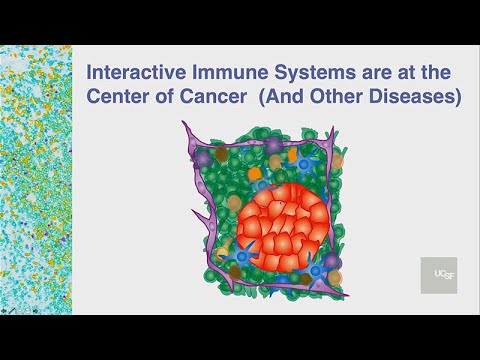
Understanding and Treating Cancer and Other Diseases Through the Immune System | 2019
Understanding and Treating Cancer and Other Diseases Through the Immune System | 2019 Ambakisye-Okang Dukuzumurenyi 20 Views • 5 years ago

Interactive immune systems are at the center of cancer and other diseases. Dr. Matthew Krummel explores how the immune system can regulate cancer progression. Recorded on 10/31/2019. [12/2019] [Show ID: 35239]

More from: Next: UCSF Scientists Outline What’s To Come
(
https://www.uctv.tv/mini-med-next)

UCTV is the broadcast and online media platform of the University of California, featuring programming from its ten campuses, three national labs and affiliated research institutions. UCTV explores a broad spectrum of subjects for a general audience, including science, health and medicine, public affairs, humanities, arts and music, business, education, and agriculture. Launched in January 2000, UCTV embraces the core missions of the University of California -- teaching, research, and public service – by providing quality, in-depth television far beyond the campus borders to inquisitive viewers around the world.
(https://www.uctv.tv)

General Toussaint L'ouverture: What You Didn't Know About the Haitian Revolution
General Toussaint L'ouverture: What You Didn't Know About the Haitian Revolution King Kevin 20 Views • 5 years ago

General Toussaint L'ouverture: What You Didn't Know About the Haitian Revolution with King Kevin Dorival http://www.kevindorival com

$Courage2believe - Gift for Professor Jean-Claude Exulien Donations can be mailed: PO Box 150071 Atlanta, GA. 30315#HaitianFlagDay #ToussaintLouverture #haitianrevolution

Showing 883 out of 884