- General Videos
- Music
- Economics
- Health
- Travel & Events
- History
- Psychology
- Spirituality
- Movies
- News & Politics
- Kmtyw Combat Sciences
- Ɔbenfo Ọbádélé Kambon Videos
- Ɔbenfoɔ Kamau Kambon: Black Liberation Philosophy
- Science, Tech, Engineering and Math
- Permaculture
- Self-Sustainability
- Living Off Grid
- Yoruba Language Learning
- Education
- Mmɔfra Adesua
- Nana Kamau Kambon Playlist
- Livestream
- Komplementarity Kouples and Revolutionary Singles
- Abibitumi Film Series
- Decade of Our Repatriation
- Live
Top videos


Your eyes and ears don’t tell you the truth. That’s not what they’re for. The senses evolved to enable us to survive and succeed in the world, not to represent it accurately. Now, for the first time, science is revealing exactly how the sense organs receive information, process it, and pass it to the brain, providing deep insight into why we experience the world the way we do—and what it might be like for future technology to transform such experiences, perhaps allowing us to see infrared light or feel magnetic north. Join an eminent group of neuroscientists and philosophers for an ear, tongue, nose and eye-opening adventure that challenges everything we experience in search of the true nature of reality.
PARTICIPANTS: Christine Constantinople, Donald Hoffman, Stavros Lomvardas, Beau Lotto, Anil Seth
MODERATOR: Elizabeth Vargas
MORE INFO ABOUT THE PROGRAM AND
PARTICIPANTS: https://www.worldsciencefestiv....al.com/programs/the-
This program is part of the BIG IDEAS SERIES, made possible with support from the JOHN TEMPLETON FOUNDATION.
TOPICS
0:00 - Program introduction
0:40 - Beau Lotto perceptual biases demonstrations
9:01 - Panelist introductions
11:10 - What is accurate perception?
15:45 - Neural basis of decision biases
17:49 - The illusion of smell
19:07 - “The dress” photo illusion
26:02 - Has our survival relied on one sense more than another?
28:21 - Contextual nature of the brain demonstration
33:00 - Does an independent reality exist?
35:09 - The umwelt
39:50 - How we perceive change
42:40 - Expectations vs. evidence in the sensory world
43:46 - Do some senses work faster than others?
49:50 - How does high emotion affect our senses?
50:43 - Synesthesia
57:00 - Neural networks studying perception
59:34 - The rubber hand illusion
1:04:20 - Do we really only have 5 senses?
1:06:52 - Parting thoughts on reality vs. perception
PROGRAM CREDITS
- Produced by Andy Meyer
- Associate Produced by Matt Carlstrom
- Music provided by APM
- Additional images and footage provided by: Venturebeat, Upload VR, Your Discovery Science
- Recorded at Gerald W. Lynch Theatre at John Jay College
- SUBSCRIBE to our YouTube Channel and "ring the bell" for all the latest videos from WSF
- VISIT our Website: http://www.worldsciencefestival.com
- LIKE us on Facebook: https://www.facebook.com/worldsciencefestival
- FOLLOW us on Twitter: https://twitter.com/WorldSciFest

In this video, we are going to answer the question "What are Frieze Patterns" and talk about different kinds of Frieze patterns. At the end of this video, you will learn mathematics in patterns that we see in our modern world.
Introduction: (0:00)
Definition of Frieze Patterns: (0:19)
Kinds of Frieze Patterns (1:55)
How to make your own Frieze pattern using modulo n (10:07)
How to make your own Frieze pattern using Geogebra (31:40)
Want to watch more videos like this?
📺 SUBSCRIBE to my channel here: http://bit.ly/mathhubtv
🌐 Website: https://mathhubtutorial.com/mathvideotutorials/
👍 Facebook: https://www.facebook.com/mathhubtutorials
🐦Twitter: https://twitter.com/mathhub303
🙋♂️ Have questions? I'm here to help you learn your math courses in an easy way. Leave a comment below and I will try to answer it as soon as I can. You can also leave topics that you need help with and I will create those videos for you.


Intelligence was once thought to be uniquely human. But researchers have discovered astonishing cognitive abilities in many other species—not just our close cousins like chimps, or fellow mammals like dolphins—but also crows, parrots, and even octopuses. If we consider the intelligence of swarms, we must add bees, termites, and ants to the list of super smart creatures. Join the scientists who study smarts as we ask: What is intelligence? Why do some species get an extra dose? And just how special are humans, really?
This program is part of the BIG IDEAS SERIES, made possible with support from the JOHN TEMPLETON FOUNDATION.
PARTICIPANTS: Simon Garnier, Suzana Herculano-Houzel, Frank Grasso, Denise Herzing
MODERATOR: Faith Salie
MORE INFO ABOUT THE PROGRAM AND
PARTICIPANTS: https://www.worldsciencefestiv....al.com/programs/reth
- SUBSCRIBE to our YouTube Channel and "ring the bell" for all the latest videos from WSF
- VISIT our Website: http://www.worldsciencefestival.com
- LIKE us on Facebook: https://www.facebook.com/worldsciencefestival
- FOLLOW us on Twitter: https://twitter.com/WorldSciFest
![Professor Eric Laithwaite: Motors Big and Small [1971]](https://i.ytimg.com/vi/oWiYsRi2Dss/hqdefault.jpg)
Professor Eric Laithwaite (1921-1997) of Imperial College London demonstrates the difference between magnetic and electro-magnetic motors. Examples futuristic - include minute pump that can fit inside human tissue and a huge test rig to help develop high speed vehicles driven by a linear motor.
This is one of a series of 16mm colour films made for schools. They were all made in Eric Laithwaite's "Heavy Electrical Laboratory" in the Electrical Engineering Department at Imperial College London.
For more on Eric Laithwaite:
http://www2.imperial.ac.uk/blo....g/videoarchive/2009/


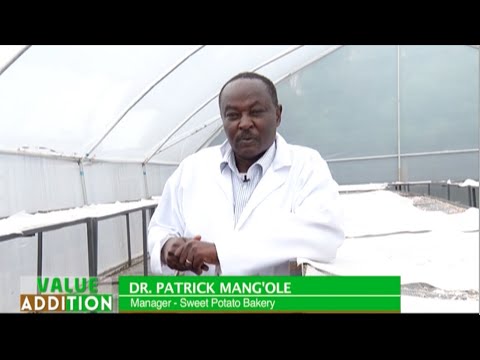
#SweetPotato #ValueAddition
www.Farmers.co.ke is the site for authoritative multimedia agricultural and agribusiness content.
Visit us today for farming news, agribusiness tips, practical expert advice and industry updates.
SMS: 22071