- General Videos
- Music
- Economics
- Health
- Travel & Events
- History
- Psychology
- Spirituality
- Movies
- News & Politics
- Kmtyw Combat Sciences
- Ɔbenfo Ọbádélé Kambon Videos
- Ɔbenfoɔ Kamau Kambon: Black Liberation Philosophy
- Science, Tech, Engineering and Math
- Permaculture
- Self-Sustainability
- Living Off Grid
- Yoruba Language Learning
- Education
- Mmɔfra Adesua
- Nana Kamau Kambon Playlist
- Livestream
- Komplementarity Kouples and Revolutionary Singles
- Abibitumi Film Series
- Decade of Our Repatriation
- Live
Top videos
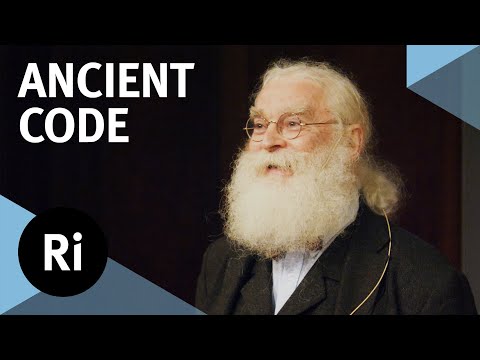

Writing is generally agreed to be among the greatest inventions in human history, perhaps the greatest invention, since it made history possible.
Subscribe for regular science videos: http://bit.ly/RiSubscRibe
You can read more about Irving's quest to explore the Noah's Ark myth in "The Ark Before Noah: Decoding the Story of the Flood": https://geni.us/zU95bVO
or learn more about cuneiform writing in "Cuneiform": https://geni.us/eMPb
Writing seems to have been invented in the late fourth millennium BC in Mesopotamia in the form of wedge-shaped marks pressed into soft clay with a reed stylus: the script known as cuneiform. Through his work on this ancient language, Irving Finkel, has uncovered amazing secrets from over five thousand years ago, including the story behind Noah’s ark.
Irving Finkel is the curator in charge of cuneiform inscriptions on tablets of clay from ancient Mesopotamia at the British Museum, of which the Middle East Department has the largest collection of any modern museum. This work involves reading and translating all sorts of inscriptions, sometimes working on ancient archives to identify manuscripts that belong together, or even join to one another. He is the author of The Ark Before Noah: Decoding the Story of the Flood.
This talk was filmed in the Ri on 18 January 2019.
---
A very special thank you to our Patreon supporters who help make these videos happen, especially:
Dave Ostler, David Lindo, David Schick, Erik Shepherd, Greg Nagel, Ivan Korolev, Joe Godenzi, Julia Stone, Kellas Lowery, Lasse T. Stendan, Lester Su, Osian Gwyn Williams, Paul Brown, Radu Tizu, Rebecca Pan, Robert Hillier, Roger Baker, and Will Knott.
---
Subscribe for regular science videos: http://bit.ly/RiSubscRibe
The Ri is on Patreon: https://www.patreon.com/TheRoyalInstitution
and Twitter: http://twitter.com/ri_science
and Facebook: http://www.facebook.com/royalinstitution
and Tumblr: http://ri-science.tumblr.com/
Our editorial policy: http://www.rigb.org/home/editorial-policy
Subscribe for the latest science videos: http://bit.ly/RiNewsletter
Product links on this page may be affiliate links which means it won't cost you any extra but we may earn a small commission if you decide to purchase through the link.


Support our work: https://democracynow.org/donate/sm-desc-yt
Elon Musk was born in 1971 in Johannesburg, South Africa, and raised in a wealthy family under the country's racist apartheid laws. Musk's family history reveals ties to apartheid and neo-Nazi politics. We speak with Chris McGreal, reporter for The Guardian, to understand how Musk's upbringing shaped his worldview, as well as that of his South African-raised colleague Peter Thiel, a right-wing billionaire who co-founded PayPal alongside Musk. "Musk lived what can only be described as a neocolonial life," said McGreal. "If you were a white South African in that period and you had any money at all, you lived with servants at your beck and call."
Democracy Now! is an independent global news hour that airs on over 1,500 TV and radio stations Monday through Friday. Watch our livestream at democracynow.org Mondays to Fridays 8-9 a.m. ET.
Subscribe to our Daily Email Digest: https://democracynow.org/subscribe


Otumfuo Osei Tutu II arPt. 2 Ɔbenfo Ọbádélé Kambon Discusses Otumfoɔ Ɔsɛe Tutu II arriving for the Asantehemmaa’s final ritesrives for the Asantehemaa’s final rites #joyprime