- General Videos
- Music
- Economics
- Health
- Travel & Events
- History
- Psychology
- Spirituality
- Movies
- News & Politics
- Kmtyw Combat Sciences
- Ɔbenfo Ọbádélé Kambon Videos
- Ɔbenfoɔ Kamau Kambon: Black Liberation Philosophy
- Science, Tech, Engineering and Math
- Permaculture
- Self-Sustainability
- Living Off Grid
- Yoruba Language Learning
- Education
- Mmɔfra Adesua
- Nana Kamau Kambon Playlist
- Livestream
- Komplementarity Kouples and Revolutionary Singles
- Abibitumi Film Series
- Decade of Our Repatriation
- Live
Top videos


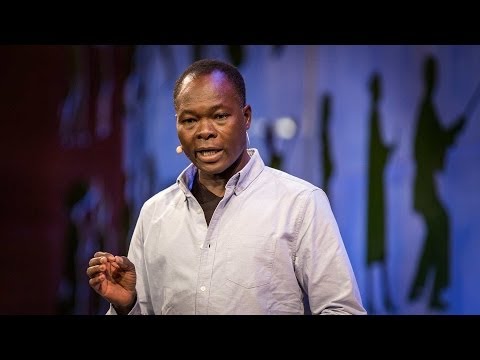

Diébédo Francis Kéré knew exactly what he wanted to do when he got his degree in architecture... He wanted to go home to Gando in Burkina Faso, to help his neighbors reap the benefit of his education. In this charming talk, Kéré shows off some of the beautiful structures he's helped to build in his small village in the years since then, including an award-winning primary school made from clay by the entire community.
TEDTalks is a daily video podcast of the best talks and performances from the TED Conference, where the world's leading thinkers and doers give the talk of their lives in 18 minutes (or less). Look for talks on Technology, Entertainment and Design -- plus science, business, global issues, the arts and much more.
Find closed captions and translated subtitles in many languages at http://www.ted.com/translate
Follow TED news on Twitter: http://www.twitter.com/tednews
Like TED on Facebook: https://www.facebook.com/TED
Subscribe to our channel: http://www.youtube.com/user/TEDtalksDirector
![Dr. Martin Luther King Jr.: The Three Evils of Society - War, Racism and Poverty [1967]](https://i.ytimg.com/vi/6sT9Hjh0cHM/hqdefault.jpg)

Don't forget to subscribe: https://bit.ly/2Hb8hjx
Watch more interesting videos: https://bit.ly/34ogCaw
Follow Channels Television On:
Facebook: https://www.facebook.com/channelsforum/
Twitter: https://twitter.com/channelstv
Instagram: https://www.instagram.com/chan....nelstelevision/?hl=e
Get more news on our website: https://www.channelstv.com/
#ChannelsTv


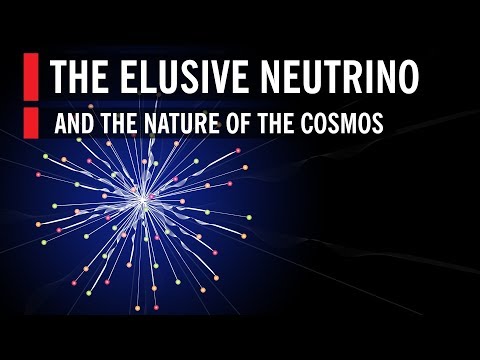
The neutrino is among the cagiest of particles, a subatomic wisp so ephemeral it could pass through light years of lead with more ease than a hot knife through butter. Despite its extraordinary abundance in the universe—billions pass through your body every second—this ghostly particle is notoriously difficult to trap, inspiring some of the most sophisticated detectors in science just to study it. A closer look could change everything. The elusive neutrino holds clues to some of the most profound questions in particle physics: What happened in the briefest moments after the Big Bang? Why does the universe contain more matter than antimatter? Join leading researchers as they chase neutrinos and other elusive particles in search of nature’s fundamental order.
This program is part of the Big Ideas Series, made possible with support from the John Templeton Foundation.
The World Science Festival gathers great minds in science and the arts to produce live and digital content that allows a broad general audience to engage with scientific discoveries. Our mission is to cultivate a general public informed by science, inspired by its wonder, convinced of its value, and prepared to engage with its implications for the future.
Subscribe to our YouTube Channel for all the latest from WSF.
Visit our Website: http://www.worldsciencefestival.com/
Like us on Facebook: https://www.facebook.com/worldsciencefestival
Follow us on twitter: https://twitter.com/WorldSciFest
Original program Date: June 1, 2012
MODERATOR: Bill Weir
PARTICIPANTS: Janet Conrad, Francis Halzen, Lawrence Krauss, John Robinson
Tiny Ghosts - Musical introduction by John Robinson 00:00
Bill Weir's Introduction 3:48
Participant Introductions 5:00
Why are neutrinos important? 6:28
Why go to the antarctic to find neutrinos? 8:44
The ghost particle appears 11:50
Many didn't believe in the neutrino. 16:20
Neutrinos from an atom bomb. 19:45
Ray Davis and his gutsy experiments. 24:08
Key predictions of the standard model. 28:30
Understanding neutrino oscillations. 31:49
Neutrinos and the Grand Unified Theory. 39:24
The supernova that led to neutrinos. 44:02
How do you measure the information from neutrinos. 53:29
A telescope under the ice? 57:00
What is the holy grail on neutrinos. 1:02:00
You can't adjust nature just observe it. 1:07:32
The truth is stranger then star trek? 1:14:20
Can neutrinos move faster than light? 1:18:46
![Professor Eric Laithwaite: The Circle of Magnetism [1968]](https://i.ytimg.com/vi/0tJfqMYHaQw/hqdefault.jpg)
Professor Eric Laithwaite (1921-1997) of Imperial College London demonstrates some of the most difficult concepts in electricity & magnetism.
This is one of a series of 16mm colour films made for schools. They were all made in Eric Laithwaite's "Heavy Electrical Laboratory" in the Electrical Engineering Department at Imperial College London.
For more on Eric Laithwaite:
http://www2.imperial.ac.uk/blo....g/videoarchive/2009/

More African Americans are heading to college these days but a new study finds that too many are in low earning majors.
A study by Georgetown University's Center on Education and the Workforce notes that African Americans who got Bachelor's Degrees in STEM fields science, technology, engineering and mathematics can earn up to 50 percent more than those who majored in arts, psychology or social work.
_
Listen, download and subscribe to the ALL NEW Roland Martin Unfiltered Audio Podcast on iTunes http://ow.ly/Hctl30eeN19
Visit Roland Martin's NEW digital lifestyle and information website http://AllThat.tv
Hit the thumbs up button and subscribe to the channel to see more content like this. http://bit.ly/2ubQ9NV
Want more Roland Martin? Watch NewsOne Now every weekday morning starting at 7AM ET on TV One.
Follow Roland Martin on the following social media platforms:
Facebook: http://bit.ly/2dgI2GO
Twitter: http://bit.ly/2dgFOra
Instagram: http://bit.ly/2d48Acu
For more info about Roland visit http://www.rolandsmartin.com
Roland Martin Podcast on iTunes: http://apple.co/2iado2r
NewsOne Now Podcast on iTunes: http://apple.co/2abI3f4
NewsOne Now Podcast on Google Play Music: http://bit.ly/2iAhm7t