- General Videos
- Music
- Economics
- Health
- Travel & Events
- History
- Psychology
- Spirituality
- Movies
- News & Politics
- Kmtyw Combat Sciences
- Ɔbenfo Ọbádélé Kambon Videos
- Ɔbenfoɔ Kamau Kambon: Black Liberation Philosophy
- Science, Tech, Engineering and Math
- Permaculture
- Self-Sustainability
- Living Off Grid
- Yoruba Language Learning
- Education
- Mmɔfra Adesua
- Nana Kamau Kambon Playlist
- Livestream
- Komplementarity Kouples and Revolutionary Singles
- Abibitumi Film Series
- Decade of Our Repatriation
- Live
Top videos



Film by Sorious Samura and Clive Patterson
How political corruption is turning the country's spiralling youth unemployment into a threat to society.
You can witness the same scene at dawn every morning in Kenya's capital, Nairobi: thousands of young people in search of work are streaming out from the city's slums towards its industrial areas.
Most of them are neatly if simply dressed, many of them are full of optimism, but the vast majority are destined to be disappointed. Those that can afford it will try and cram onto a bus in an attempt to beat the crowds, the rest will weave their way on foot through the heavy morning commuter traffic. But when they arrive, the situation for all of them will invariably be the same as it was on the previous day and the day before that and on all the other preceding days.
They will spend an hour or so packed in their hundreds along the pavements and parking lots outside a factory, warehouse or office block, certificates of education and references from previous employers ready to hand, waiting patiently for something to happen.
The usual rumours pass from person to person, this company is said to need people with computer skills, that one needs fork lift truck drivers or perhaps some just some day laborers. But then a supervisor will step from the building and shout out that he can offer a day's work for four people with experience of working a lathe or two with secretarial skills.
Many step forward, a lucky few are selected at random and make their way inside, then the doors of the building close and the rest drift off to take up station at the next place or to make their long way back home - hopes dashed yet again.
A national disaster in the making?
George, a Kenyan in his early twenties, has graduated from university in December 2012 with a diploma in electrical engineering but so far he has been unable to find work.
"The chance I'm going to be chosen today is limited," he says. "I'm just gambling. You can stand here for as long as half a day, because you never know the time that you can be picked."
It is a story that is all too common. Joblessness among all people of working age is a serious problem in Kenya, but among young people, it is a catastrophe. The country has one of the largest youth populations in Africa, but roughly 70 percent of its working age youth - almost 10 million people - are unemployed, although a surprising number are very well educated and possess the kinds of skills a healthy economy really should be able to put to use.
In a country where almost 80 percent of the population is under the age of 35 some have labelled it a national disaster in the making, that may have serious social consequences and lead to civil unrest.
For a country that is still recovering from the scars of the widespread community violence that followed the 2007 election and which is still reeling from the aftermath of the al-Shabab Westgate mall terrorist attack in September 2013, it is a hint worth taking seriously.
Dr Alex Ezeh of the African Population and Health Research Centre in Nairobi put the significance of this youth population 'bulge' in context.
"It is a demographic event," he says. "It's something that many countries go through at different stages as they move from very high fertility and mortality to very low mortality, it creates this reservoir of people." But this, as he explained, can have positive and negative consequences.
"Generally, what makes it a good thing is our ability to harness the economic potential of such a large proportion of young people going into the labour market … There is a side of it, the more negative part of it, which is, if there are no jobs and no opportunities to engage, then you have a lot of young people understanding what is going on but they're disenfranchised politically, economically, and in many other ways, and this creates a lot of political instability."
The stark reality for the young people from the huge slums at Kibera and Mathare and elsewhere around Kenya's capital is that life without a job is extremely difficult. With no regular income many of them have to turn to crime to make a living. And even if they do not, they are often suspected of involvement in crime, which in turn leads to deadly entanglements with Kenya's notoriously trigger-happy police.
A generation pushed to the edge
When asked who should be doing what about Kenya's youth unemployment, the answer is clear. Successive governments in Kenya have done little to alleviate the plight of the jobless and should be doing more.
- Subscribe to our channel: http://aje.io/AJSubscribe
- Follow us on Twitter: https://twitter.com/AJEnglish
- Find us on Facebook: https://www.facebook.com/aljazeera
- Check our website: https://www.aljazeera.com/
#AlJazeeraEnglish #KenyaUnemployement


SEMINAR TITLE: “Black People in the Biblical Lands of Kush andEgypt & Their Contributions to the World.”
6) Ancient African contributions in Architecture and a practical application of the practical knowledge learned about classical African civilizations
Background:Presenter is Professor Manu Ampim:Prof. Manu Ampim is the director of Advancing The Research and is a noted historian and scholar specializing in Africana Studies. He has conducted primary (first-hand) research in nearly two dozen countries over the past 30 years, and is the author of numerous scholarly articles and several books, including his latest work, A History of African Civilizations (2019). Prof. Ampim is also a tenured professor at Contra Costa College (San Pablo, CA) and Chair of the History, Anthropology, and Geography Department. In addition, he has facilitated various workshops throughout North America, and has worked with several renowned scholars.Week 1 Resources document that Professor Ampim compiled to help support the attendees of the class last week and to further answer the main questions that were raised. I noted in the Bibliography that my book, A History of African Civilizations ($24.95), is the most relevant source for the 6-week seminar and can be ordered below.https://advancingtheresearch.org/prod... This Seminar is part of the Brother-to-Brother Education SeriesHosted by the Brother-to-Brother Grouphttps://www.brother-to-brother.org/Comments are turned off. Learn more
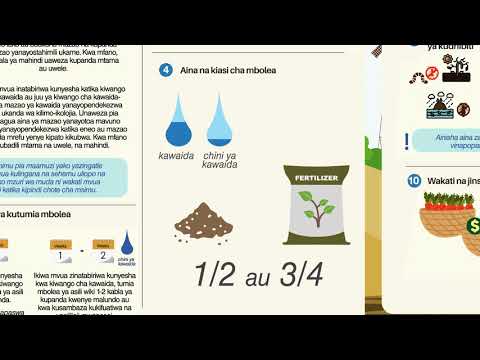
Video hii inaonyesha maamuzi 10 makuu ya kilimo ya kufanya kulingana na habari ya hali ya hewa.
Tazama toleo la Kiingereza kwenye kiunga hapa chini:
https://youtu.be/kSxTq4OW1Fg
Sifa za video:
USDA, USAID, IITA, Kilimo cha Misitu Ulimwenguni, FAO.
Tutembelee → https://iita.org/
Ikiwa wewe ni mpya, tafadhali jiandikishe!
Tutembelee → https://iita.org/
Kama sisi → https://facebook.com/IITA.CGIAR
Tufuate → https://twitter.com/iita_cgiar
Tufuate → https://instagram.com/iita_cgiar/
Pata habari zetu zote za hivi karibuni → http://bulletin.iita.org/
#IITA #kilimo #haliyahewa





Welcome to 2nacheki news: Israel is reportedly banning the entry of Ethiopian pilgrims who want to embark on a pilgrimage to the country during this year's Easter Celebrations.
Thank you for watching!
Have you liked this video yet? This is the greatest thing you can do to support our channel. Also please subscribe and share this video with friends and family.
Buy our Official Merchandise here https://www.2nacheki.shop/
Visit our Links: https://linktr.ee/2nacheki
Israel is Now Banning Ethiopian Pilgrims from Entering the Country for Easter Celebration https://youtu.be/Ux_5wzTpm9c #Africanews #Ethiopianews
2nacheki pronounced tunacheki which means 'We Are Watching ' in Swahili slang. Our goal is to educate, inform & entertain you all about the real Africa while showing the World that Africa is Watching.
We create numerous videos every day on African topics like Africa Lists Africa News Africa Music Africa Dances Africa Speeches Africa Entertainment Africa History Africa Interviews Africa Documentaries Panafricanism Africapop-culture African culture African Politics and more
Please contact us for tips, content submission, Ads, Takedowns, Collabos, Complaints, Reporting, and Inquiries #Africa #Africanews #2nacheki




Have you heard of Inductive and Deductive Reasoning? How is it used in Mathermatics? What does Conjecture mean? Watch this video to know more…
To watch more High School Math videos, click here - https://bit.ly/HighSchoolMath_DMYT
Don’t Memorise brings learning to life through its captivating educational videos. To Know More, visit https://DontMemorise.com
New videos every week. To stay updated, subscribe to our YouTube channel : http://bit.ly/DontMemoriseYouTube
Register on our website to gain access to all videos and quizzes:
http://bit.ly/DontMemoriseRegister
Subscribe to our Newsletter: http://bit.ly/DontMemoriseNewsLetter
Join us on Facebook: http://bit.ly/DontMemoriseFacebook
Follow us on Twitter: https://twitter.com/dontmemorise
Follow us : http://bit.ly/DontMemoriseBlog
#Mathematics #Induction



“It was Martin’s precious blood. This blood was shed for us.’ Jesse puts his hands in the blood and wipes it on his shirt. What do you do in a moment like that?” — Andrew Young on Jesse Jackson shortly after MLK, Jr. was shot
Who Killed MLK? The Question STILL Remains
Every 3rd Monday in January, we hear Rev. Martin Luther King, Jr’s famous, “I Have A Dream” speech, but if you research this still mysterious murder—and even deeper, the days that led up to his assassination—you’ll find it really was (and continues to be) a nightmare!
This nightmare became even more deceitful when white media labeled James Earl Ray the lone assassin. While most accepted, there are those that knew there was another side of the story that wasn’t been heard.
Find out about Jesse Jackson’s role in my 4th book, ‘Who Iz the Boulé?: The History of America’s First Black Fraternity and the Derailment Toward Afrikan Self-Reliance available in paperback, audiobook, eBook, and digital PDF.
Visit
http://daghettotymz.com for details (link also in Bio).
Each one REACH MANY! ✊🏿❤🖤💚
.
.
.
#DaGhettoTymz30thYear #MLK #WhoIsTheBoule#AfricanHistoryMonth365 #TheHistoryYouDontKnow



Today we will explore the political application of Afrikan Identity throughout history to the present day; and the necessity of clarity in Identity as a foundation Afrikan problem solving and visionary nation building. This presentation also serves as a challenge to the present day attempts to negate the concept of Afrikan Identity; and/or neutralise its political application & power potential.
Chapters
00:00 - Words from the Elders & Ancestors
14:08 - Introduction
20:51 - Defining Terms
49:22 - PART1
DECONSTRUCTION
53:01 - How Colonialism redefined Afrikan Historical Consciousness
1:05:29 - The Indecencies of "Tribe"
1:12:40 - How the Coloniser disrupted Afrikan Social Order
1:17:02 - Did Afrikans Organise Nations Beyond "Tribe"
1:22:58 - PART 2
RECONSTRUCTION
1:26:21 - Defining Liberation
1:32:40 - Historical Consciousness IS Political
1:38:39 - The FACT of Afrikan Cultural Unity
1:50:59 - Why we emphasise Afrikan Identity as POLITICAL
2:14:32 - Afrikan Identity, Nationhood & the Rejection of the Coloniser
2:19:38 - Nkrumah & Lumumba - Examples from the Afrikan Continent
2:30:11 - Omowale Malcolm X & Afrikan Identity
2:26:21 - Afrikan Identity as a Threat to Western Imperialism
2:41:18 - Afrikan Identity in the 21st Century - Continent & Diaspora
2:54:26 - Universal Afrikan Nationalism
3:01:46 - Interaction with the chat
Related presentation:Pan-Afrikan Culture & Economics in Practice: https://youtu.be/Q1GFqTGpvzgDefinitions of
Pan-Afrikanism: Preview to the Ancient Origins: https://youtu.be/E8KWImibNyI
Decolonising African Land & Nations States - Foluke Adebisi https://youtu.be/WlC62vI4D0o
If you Would Like: https://www.paypal.me/abengapparel
► ABIBITUMI: https://www.abibitumi.com/members/shakara/
► ABIBITUMITV: https://abibitumitv.com/@ShakaRa
► Subscribe: https://www.youtube.com/shakar....aspeaks/?sub_confirm
► Twitter https://twitter.com/ShakaRaSpeaks
► Facebook: https://www.facebook.com/ShakaRaSpeaks/
► Instagram: https://www.instagram.com/shakaraspeaks/
![Alex Haley - His Search For Roots [1977]](https://i.ytimg.com/vi/Kq7lID_KfKY/hqdefault.jpg)