- General Videos
- Music
- Economics
- Health
- Travel & Events
- History
- Psychology
- Spirituality
- Movies
- News & Politics
- Kmtyw Combat Sciences
- Ɔbenfo Ọbádélé Kambon Videos
- Ɔbenfoɔ Kamau Kambon: Black Liberation Philosophy
- Science, Tech, Engineering and Math
- Permaculture
- Self-Sustainability
- Living Off Grid
- Yoruba Language Learning
- Education
- Mmɔfra Adesua
- Nana Kamau Kambon Playlist
- Livestream
- Komplementarity Kouples and Revolutionary Singles
- Abibitumi Film Series
- Decade of Our Repatriation
- Live
Top videos
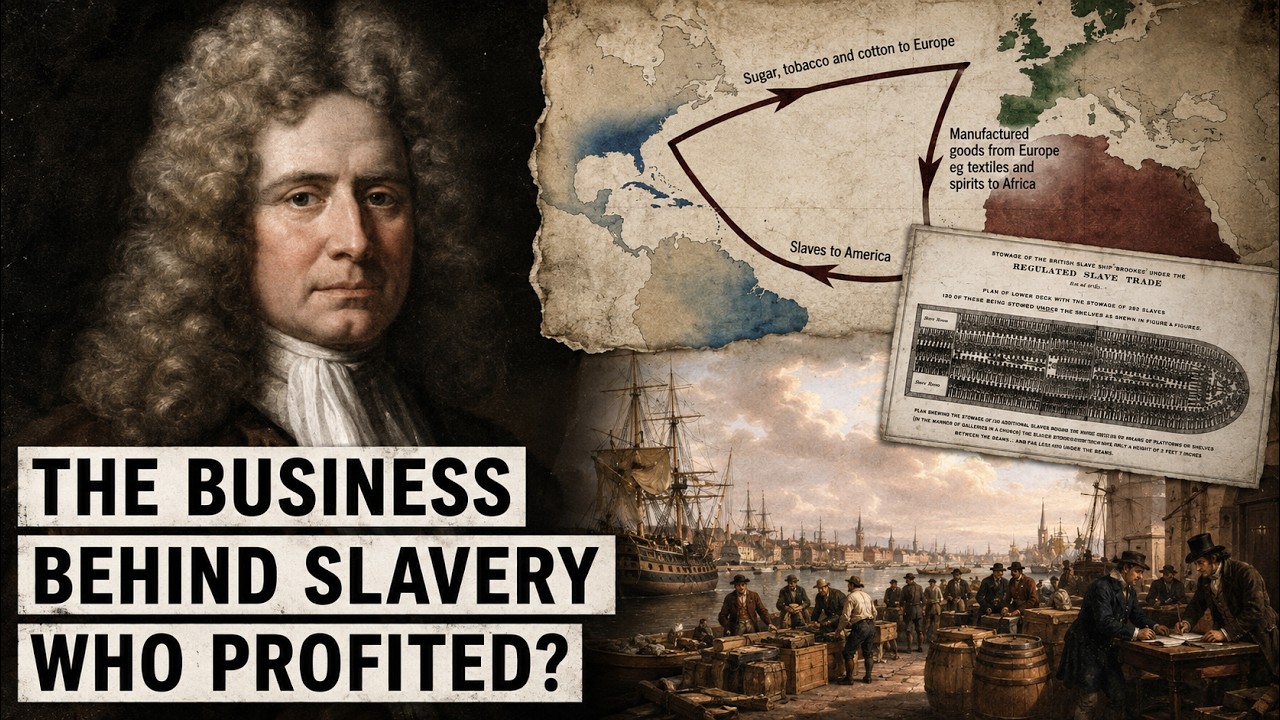

The Atlantic slave trade wasn't just a moral catastrophe — it was the most profitable business operation in human history. For over three centuries, a vast financial machine connected three continents, generating wealth that built cities, funded banks, bankrolled the Industrial Revolution, and created dynastic fortunes that are still compounding today.
In this video, we follow the money. From the Portuguese trading posts of the 1400s to the boardrooms of Lloyd's of London. From the sugar plantations of Jamaica, where enslaved workers had a life expectancy of seven years, to the grand townhouses of Liverpool, where merchant families lived in extraordinary luxury funded by human cargo. From the Royal African Company — a crown-backed corporation that branded enslaved people with its initials — to the Bank of England, whose early governors profited directly from the slave economy.
We examine the triangular trade not as a historical diagram, but as a fully integrated global financial system. We look at who invested, who insured, who extended credit, and who collected the dividends. We explore how slave trade profits became the seed capital for Britain's Industrial Revolution, how New England merchants ran closed-loop supply chains of rum, sugar, and enslaved people, and how the British government paid slave owners £20 million in compensation when slavery was abolished — a debt so large that British taxpayers were still paying it off in 2015.
This is the story of who really profited from the Atlantic slave trade, and why the financial architecture they built is still shaping the world today.
If you found this valuable, please like, subscribe, and share this video. It helps more than you know.
#atlanticslavetrade #slaveryandcapitalism #whoreallyprofited #triangulartrade #slavetradeeconomics #royalafricancompany #lloydsoflondon #britishempire #sugarplantations #industrialrevolution #ericwilliams #capitalismandslavery #liverpool #bristol #middlepassage #slavetradehistory #colonialwealth #economichistory #hiddenhistory #moneyandpower #macrofinance #globaleconomics



We are happy to welcome Bevin Magama to 'Africanus Talks' to discuss his passion for professional storytelling and writing. Bevin travels extensively around the UK and internationally conducting themed storytelling workshops alongside his own live performances. In both schools and workplaces, Bevin's wealth of knowledge about 'Storytelling' as more than just an art form, but a cultural backbone much needed within Africanus communities is exhaustive. Bevins skills allow him to use storytelling to challenge bullying in workplaces, conflict resolution, while still creating a safe environment renowned for being fun, building confidence, improving literacy and oracy in schools. We hope you enjoy this introspective interview from our brother Bevin Magama!
Bevin Magama Socials & Websites
Website - http://bevinmagama.com/
Twitter - https://twitter.com/bevin_magama
Facebook - https://www.facebook.com/StorytellerM...
YouTube - https://www.youtube.com/channel/UCFfv...
Website - www.Africanusworld.com
Pateron - https://www.patreon.com/AfricanusWorld
Facebook - https://www.facebook.com/AfricanusWorld/
Twitter - https://twitter.com/AfricanusWorld
Instagram - https://www.instagram.com/aricanusworld/
Pay Pal - https://www.paypal.com/cgi-bin/webscr...
![Meet the Rainwater Harvesting Champions of Ethiopia, Kenya and Uganda [2016]](https://i.ytimg.com/vi/xJLTuJZ2vL8/hqdefault.jpg)

RAIN is all about rainwater harvesting, check http://www.rainfoundation.org/
Sufficient and safe water should be available to everyone. Unfortunately, many people don’t have access to safe water. How to change that? Harvest rainwater!
Since its foundation in 2003, RAIN has been working with its partners to develop, spread and implement rainwater harvesting systems.
The idea is simple. There is hardly a place in the world where it never rains. Rainwater belongs to everyone. And the methods to collect, store, use and reuse rainwater (to ‘harvest’ rainwater) are easy to apply. So why not spread those methods around the world?
Rainwater harvesting: for whom?
We aim to motivate and help as many people as possible to apply these methods in a sustainable and effective way, whether the water is for domestic, productive or environmental purposes.
Our focus is on making the concept and practice of rainwater harvesting (RWH) familiar to people in areas that lack sufficient and safe water sources.
![Ancient Construction Tech Adopted by High End Architects [2019]](https://i.ytimg.com/vi/X-d_9-uXLNA/hqdefault.jpg)
(13 Jan 2019) LEADIN:Rammed earth is a construction method that has been around for millennia, but it's attracting renewed interest in countries like the USA and Australia. In Ghana a construction company is returning to the technique of rammed earth building, promoting its eco-friendly and economical technique. STORYLINE: This construction worker is part of a team building an eco-friendly house near Ghana's capital city, Accra.He is compressing a mixture of raw materials mostly sourced from within two kilometres.When the temporary structure is later removed it will reveal a solid wall – the beginning of a house. The technique is called rammed earth, as co-founder of Hive Earth Kwame de Heer explains."Rammed earth is a really old technique. Here in Ghana we have always built houses using mud, but here we have modernised it. We use a mixture of laterite which contains sand, a bit of silt, clay and some stones. We pour this into a temporary structure after being mixed. After pouring in eight inches we compress it to about four inches. We are mimicking a sedimentary rock, but speeding up the process. It's man-made stone."About five percent of the raw materials used in this method requires imported cement, which is necessary as a stabiliser.As well as being more eco-friendly, Hive Earth says it costs a third less than building with sandcrete blocks, commonly used in Ghana. Foster Osae-Akonnor heads up Ghana's Green Building Council:"Once you can get materials from the locality that you are working, then it helps to reduce the carbon footprint. In addition, comparing rammed earth to concrete, you save all the embodied energy that will be required in the manufacturing of cement."Compared to other building materials, a very high amount of energy is consumed to produce cement. In addition cement is imported into Ghana. Another of Hive Earth's rammed earth projects, in Accra, reveals its interesting aesthetic, which is the result of the ramming process.The technique is well suited to the hot climate of Ghana as it keeps the room temperature cool, says co-owner of Hive Earth, British-Ghanaian entrepreneur Joelle Eyeson."Rammed earth is sound proof, it's termite proof, it's thermally insulative – so it regulates the internal room temperature. Because the walls are so thick it takes a while for the heat to penetrate through to the internal room. Our walls can be anything from 12 to 15 inches thick. It's earthquake resistant as well, due to the monolithic nature of the walls as compared to sandcrete blocks, because the walls are monolithic. With sandcrete blocks you have the mortar joints so it's easier for the wall to shake and become disinbursed, whereas with rammed earth it's just one straight monolithic wall. It's as strong as concrete as well – it can last for hundreds of years." A long-standing example of rammed earth is the Great Wall of China.Williams Nimailo from the Ghana Bureau of Standards helped draw up the country's new building code.Allowance is made for rammed earth under both traditional and green building construction methods. Provision is made for modern materials such as clay-fired bricks or cement blocks. Akosua Obeng is an architect who contracted Hive Earth to build the external walls of a luxury complex in Accra.Obeng believes using rammed earth techniques in a high-end development will help to change perceptions about how earth materials can enhance design and architecture.Hive Earth have produced eight rammed earth projects since starting up in 2016, and have many more projects planned in Ghana and regionally.Find out more about AP Archive: http://www.aparchive.com/HowWeWork Twitter: https://twitter.com/AP_Archive Facebook: https://www.facebook.com/APArchives Instagram: https://www.instagram.com/APNews/You can license this story through AP Archive: http://www.aparchive.com/metad....ata/youtube/7a9be64b


Don't forget to subscribe: https://bit.ly/2Hb8hjx
Watch more interesting videos: https://bit.ly/34ogCaw
Follow Channels Television On:
Facebook: https://www.facebook.com/channelsforum/
Twitter: https://twitter.com/channelstv
Instagram: https://www.instagram.com/chan....nelstelevision/?hl=e
Get more news on our website: https://www.channelstv.com/
#ChannelsTv


The Financial Sector Clean up: Assessing the bail out - Upfront on JoyNews (17-6-21)
#The_Financial_Sector_Clean_up
#Upfront
#MyJoyOnline
https://www.myjoyonline.com/ghana-news/
Subscribe for more videos just like this:
https://www.youtube.com/channe....l/UChd1DEecCRlxaa0-h
Click to this for more news:
https://www.myjoyonline.com/


BLACK FOLKS Stop going for the okey-doke! #Reparations is the MAIN GOAL. Anything else is UNACCEPTABLE—PERIOD!! ✊🏾🖤 http://www.KevinDorival.com
#KingKevinDorival is an African-Haitian author of 3 books, filmmaker, and International activist. #Juneteenth
TW/IG: @Courage2Believe

Three health workers risk their lives to battle Ebola in a war zone.
FRONTLINE reports from inside the second-largest Ebola outbreak ever in a region of the Democratic Republic of Congo devastated by decades of conflict.
This journalism is made possible by viewers like you. Support your local PBS station here: http://www.pbs.org/donate
Love FRONTLINE? Find us on the PBS Video App where there are more than 250 FRONTLINE documentaries available for you to watch any time: https://to.pbs.org/FLVideoApp
Subscribe on YouTube: http://bit.ly/1BycsJW
#Ebola #Congo #documentary
Instagram: https://www.instagram.com/frontlinepbs
Twitter: https://twitter.com/frontlinepbs
Facebook: https://www.facebook.com/frontline
FRONTLINE is streaming more than 200 documentaries online, for free, here: http://to.pbs.org/hxRvQP
Funding for FRONTLINE is provided through the support of PBS viewers and by the Corporation for Public Broadcasting. Major funding for FRONTLINE is provided by the John D. and Catherine T. MacArthur Foundation and the Ford Foundation. Additional funding is provided by the Abrams Foundation, the Park Foundation, The John and Helen Glessner Family Trust, and the FRONTLINE Journalism Fund with major support from Jon and Jo Ann Hagler on behalf of the Jon L. Hagler Foundation.

🌍 ¿Conoces la verdadera historia de los Imperios Africanos? 🤯
En este episodio de Mikecrohpone, revelamos lo que no te contaron: desde Mansa Musa hasta los grandes imperios que dominaron África. ¡Es hora de reconectar con nuestra historia y recuperar nuestra identidad! 🚀
🔗 ¡Mira el episodio completo en YouTube y descubre la grandeza de la que venimos! 👑✨
#imperiosafricanos #mikecrohpone #historianegra #orgulloafricano #descubretuhistoria #tiktok #Instagram
¡Es hora de recuperar nuestra historia! #culturaafricana #imperiosafricanoss #identidadcultural #MúsicaYHistoria #orgulloafro #ConexiónCultural #RaícesAfricana #historiadesconocida #MúsicaConCausa #panafricanismo


Greetings Bla Xit family
This is our third Bla Xit messenger Naemah from New Jersey, USA. She shares her experiences of living in the diaspora and explains why she would like to live in Africa. She has had the courage to speak out so please leave positive comments and like, share and subscribe!
If you would like to support the channel so we can continue producing our content, you can send your donation via PayPal to bopcollective@yahoo.com
Become a Bla Xit Messenger (Subscribers only) by sending your video clip to blaxithome@gmail.com
Special thanks to our friend and YouTuber Wode Maya. You can follow him on YouTube too www.youtube.com/user/MrGhanaBabyyy

We are joined on a land tour by Crystal and her sister Alesha who are on a mission to raise funds via an Black IT Professionals from the US to ****ist African organisations from Schools to Youth projects and even the police to increase their use of IT systems. A group of us had a brilliant day. Unfortunately the Alkalo of Sanyang was not available to receive the computers for his project so they were donated to a local school. Brusabi High school' s head teacher Peter was glad for the donation of 5 computers. Bla Xit were also gifted a laptop and we are most grateful. So thank you very much. Art and Marka and A also enjoyed the day. If you would like to donate anything to Gambian orphanages, schools or villages or health centres please let us know. Via email at blaxithome@gmail.com
If you would like to support the channel you can donate via PayPal www.paypal.com
Using bopcollective@yahoo.com
Or support us via Patreon searching Bla Xit
We appreciate all your views, your likes and subscriptions. Please share our content around to like-minded Bla Xiteers.
#BlaXitfamily #Blaxit #bla xithome
Thanks to MPRA Beats ##MM
To purchase land please call via WhatsApp +23231669354 ASAP